You don’t need to own property to become an Airbnb co-host. I started with a spare bedroom in my apartment, making $65 a night. Now, I manage over $100M in properties I don’t own. The secret is co-hosting. You manage listings for other people and earn 10% to 25% of every booking for handling guest communication, cleaning, and pricing. No savings. No property. No problem. Here’s how you do it.
What Does an Airbnb Co-Host Actually Do?
Forget the official job description. You’re the owner’s problem-solver. You’re the operator who makes the cash register ring while they’re at their 9-to-5 or on vacation. An owner can add up to 10 co-hosts to a listing, and Airbnb handles the payment splits automatically. It’s clean.
Now, what you actually do depends on what you and the owner agree on. But most of the time, you’re handling this stuff:
- Guest communication: Answering questions before they book. Sending check-in details. Dealing with the “I can’t find the wifi password” messages at 11 PM. Writing reviews so they leave you a good one back.
- Booking management: You’re the gatekeeper. You approve or deny requests. You block off the calendar for maintenance. You handle cancellations.
- Cleaning coordination: This is mission control. You find reliable cleaners. You schedule them between every single guest. You check their work. You make sure supplies like toilet paper and coffee are always stocked.
- Pricing optimization: Most owners set a price and forget it. Big mistake. You use tools like PriceLabs or Wheelhouse to adjust rates daily based on demand, local events, and what the competition is doing. This is where you really make the owner money, and in turn, make yourself money.
- Maintenance: The AC breaks. A pipe bursts. A guest locks themselves out. You handle it. You have a list of handymen, plumbers, and locksmiths ready to go so you don’t have to bother the owner with every little thing.
- Listing optimization: You’re in charge of the online storefront. You update photos. You rewrite descriptions to sell the experience. You figure out how to get the listing to the top of Airbnb search.
Co-Host vs. Property Manager: What’s the Difference?
People get hung up on these titles. Don’t. The only difference that matters is the business structure and how you get paid. Here’s the thing: co-hosting is the lean, fast way to start.
| Factor | Airbnb Co-Host | Property Manager |
|---|---|---|
| Platform access | Added directly to Airbnb listing with permissions set by owner | Typically manages through their own account or management software |
| Payout | Airbnb splits payouts automatically to co-host | Usually invoices the owner separately or takes a cut before disbursement |
| Legal structure | Often informal, agreement-based | Usually requires a business license and formal contract |
| Listing ownership | Owner retains full control; co-host has assigned permissions | Manager may control listings under their own account |
| Scale | Can start with 1 listing, no license required | Typically manages 5+ properties as a registered business |
| Typical fee | 10-25% of booking revenue | 20-40% of booking revenue |
The point is, co-hosting is your entry point. You don’t need a business license or a fancy contract to manage one property for a friend. You test the waters. You prove you can get results. Then you scale up and become a full-blown property manager if you want to.
How Much Do Airbnb Co-Hosts Earn?
Let’s talk money. This isn’t theory. It’s math. Your income is based on three things: how much the property makes, your commission percentage, and how often it’s booked.
Here’s what this looks like with one single property:
- Property makes $3,000/month in gross bookings.
- Your co-host commission is 15%.
- Your monthly income: $450.
- Your annual income from one property: $5,400.
Doesn’t sound like much? You’re thinking too small. Nobody gets rich off one property. But this is a volume game. At 5 properties, that’s $2,250 a month ($27,000 a year). At 10 properties, it’s $4,500 a month ($54,000 a year). This is how I quit my $200K banking job at 33. I didn’t get one property and stop. I built a system and scaled it. In 2022 alone, my company did $1.9M in revenue from co-listing for other people.
Your commission depends on how much work you do:
- Guest communication only: 10-15%. This is the easy stuff.
- Communication + cleaning coordination: 15-20%. Now you’re managing logistics.
- Full-service management: 20-25%. You do everything. The owner just gets a check. This is what you should aim for.
Want to know exactly what to charge? Check our Airbnb co-host income guide.
How to Become an Airbnb Co-Host: Step by Step
Step 1: Understand the Platform
Don’t be a theorist. Be a practitioner. You can’t tell an owner you know how to manage an Airbnb if you’ve never used the host side of the platform. The best way to learn is to do it. If you have a spare room, list it. If you don’t, list your own apartment for a weekend while you stay with a friend. I started by renting my extra bedroom for $65 a night. That experience was my education. It taught me about messaging, cleaning, and what guests actually want.
You have to feel the pain of a 1-star review to understand how to prevent one for your clients. Get some reps in. Owners will see that you’ve actually hosted and trust you more.
Step 2: Build Your Skill Set
Nobody is going to ask for your resume. They care about results. Here are the skills that actually matter:
- Communication: You have to be fast. Airbnb’s algorithm rewards hosts who respond in under an hour. You need to be on your phone, ready to answer questions on nights and weekends. This is not a 9-to-5 job.
- Local market knowledge: You need to know your city. What are the big events? When is the high season? What are the other listings charging? This knowledge is how you make your owner more money than they could on their own.
- Problem-solving: Things will go wrong. The wifi will go out. Guests will complain about noise. You need to be the person who fixes it without calling the owner every time. You are the firewall.
- Organization: One property is easy. Five is chaos unless you have a system. You need to track cleaners, check-in times, maintenance requests, and supplies without letting anything fall through the cracks.
If you want the exact systems I used to scale, I teach them to over 1,600 students in my co-host training program. It’s the blueprint for finding clients and managing properties.
Step 3: Find Property Owners Who Need Help
This is where most people get stuck. They wait for the phone to ring. It won’t. You have to go out and find owners. They’re everywhere, and they’re overwhelmed. Here’s where to look:
Your personal network: Tell everyone you know what you’re doing. Friends, family, coworkers. Somebody knows somebody who owns a second home and is sick of managing it.
Local Facebook groups: Search for “[Your City] Airbnb Hosts” or “[Your City] Real Estate Investors.” These groups are full of owners complaining about bad guests and cleaning nightmares. That’s your opening. Offer to help.
Real estate investor meetups: Go to these events. Introduce yourself. Investors buy properties for cash flow, not to answer messages at midnight. You are the solution to their biggest headache.
Airbnb Co-Host Network: Once you have some experience, you can list yourself on Airbnb’s official marketplace. I’ll cover that in a minute.
CoHostMarket.com: This is another online marketplace connecting owners and co-hosts. Get your profile up there.
For the exact scripts and strategies I use to land clients, read my guide on how to find property owners for co-listing.
Step 4: Get Added to a Listing
The tech part is simple. Once an owner says yes, they just need to add you on Airbnb. Here’s how it works:
- The owner navigates to their listing on Airbnb.
- They click the “Co-hosts” tab.
- They click “Invite a Friend” and put in your email.
- They choose your permissions.
- You get an email, you click accept, and you’re in.
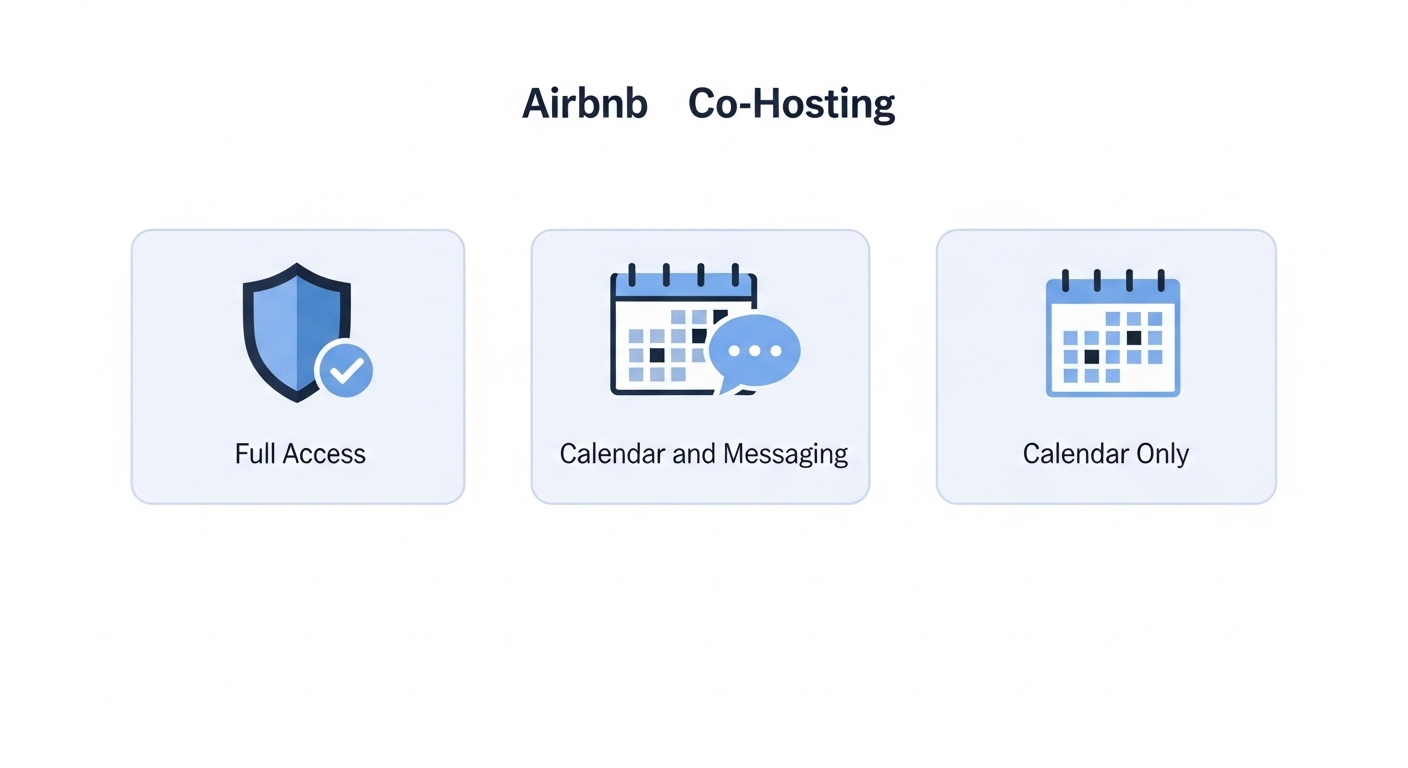
Now, about those permissions. There are three levels:
- Full access: You can do everything. Change prices, edit the listing, message guests, see the money. This is what you want.
- Calendar and messaging: You can talk to guests and see the calendar, but you can’t change anything important like pricing.
- Calendar only: You can only see who is checking in and out. Pretty useless.
Push for full access. You can’t do your job and maximize revenue for the owner without it.
Step 5: Set Up Your Co-Host Agreement
I’m going to say this once. Never, ever work on a handshake deal. My background is in banking. Everything is documented. Your business should be the same. A written agreement protects you and it protects the owner. It eliminates confusion.
Your agreement needs to spell out:
- Services you’ll provide: Be specific. List every single thing you’re responsible for.
- Compensation structure: Your percentage. How it’s calculated. When you get paid.
- Payout method: Are you using Airbnb’s automatic split, or are they paying you directly? (Use the split. It’s cleaner).
- Decision authority: What can you decide on your own? What needs the owner’s approval? Define this upfront.
- Communication expectations: How often will you update the owner? A monthly report is standard.
- Termination terms: How does this partnership end if one of you wants out?
Don’t try to write this from scratch. Use our free co-listing agreement template. It’s ready to go.
Step 6: Optimize the Listing for More Bookings
Here’s where you provide value from day one. Most owners are lazy. They upload a few photos, write a boring description, and never touch the listing again. You can do better.
Quick wins to implement immediately:
- Rewrite the title to include keywords people are searching for, like “Walk to Downtown” or “Private Hot Tub.”
- Rewrite the description. Put the best features in the first two sentences.
- Reorder the photos. The first picture should be the money shot.
- Turn on Instant Book. It boosts your search ranking.
- Set up automated messages for check-in, checkout, and asking for reviews.
- Install a dynamic pricing tool. This alone will probably increase revenue by 10-20%.
Joining the Airbnb Co-Host Network
Airbnb has its own official marketplace to connect experienced co-hosts with owners. It’s a good source for leads, but you can’t just sign up. You have to earn your way in. It’s for pros, not beginners.
Eligibility Requirements (2026)
Here’s the checklist from Airbnb’s official site. You need:
- An active listing where you’re a host or co-host with messaging access.
- A track record: 10+ stays in the last year OR 3+ stays that total at least 100 nights.
- A 4.8-star average rating or higher. This is non-negotiable.
- A cancellation rate under 3%. Don’t cancel on guests.
- A verified ID and a clear profile photo of your face.
- A response rate over 90%. I told you speed matters.
- A 4.7 rating or higher just to show up in the search results on their network.
Where the Co-Host Network Is Available
As of 2026, it’s live in: Australia, Brazil, Canada, France, Germany, Italy, Japan, Mexico, Puerto Rico, South Korea, Spain, the UK, and the US.
Profile Rules
Your name on the network has to be your personal name. Not your company name, unless you are in a few specific countries and are a registered business.
Do You Need a Business License to Co-Host?
Let’s be direct. When you start with one or two properties, you’re a contractor. You don’t need a special license in most places. You’re just getting paid a commission.
But when you scale, you’re running a business. Once you hit 5+ properties, you need to check your local laws. Many cities will classify you as a property manager, and that might require a license. Every city is different. New York and San Francisco are a nightmare. Other places are easy.
Don’t guess. Go to your city’s website and look up the rules for short-term rental management. Do it right from the start.
And for taxes, you’re getting paid as an independent contractor. Read our Airbnb co-host tax guide to make sure you handle it correctly.
Tools That Make Co-Hosting Easier
I’m a systems guy. You can’t scale a business by working more hours. You scale by building systems and using tools to automate the work. Managing 10 properties manually is a full-time job. Managing 10 properties with the right software is a few hours a week.
| Tool Category | What It Does | Examples |
|---|---|---|
| Dynamic pricing | Automatically adjusts nightly rates based on demand, seasonality, and local events | PriceLabs, Wheelhouse, Beyond Pricing |
| Channel manager | Syncs your calendar across Airbnb, VRBO, Booking.com to prevent double bookings | Hospitable, Guesty, Hostaway |
| Guest messaging | Sends automated check-in instructions, review requests, and mid-stay messages | Hospitable, TouchStay, Hostfully |
| Smart locks | Generates unique access codes for each guest, eliminating key handoffs | August, Yale, Schlage Encode |
| Cleaning management | Automatically notifies cleaners after checkout and tracks task completion | TurnoverBnB, Breezeway, Properly |
If you only get one tool, make it a pricing tool. See our dynamic pricing tools comparison to pick the right one.
Common Mistakes New Co-Hosts Make
I see the same mistakes over and over. Avoid these and you’ll be ahead of 90% of the competition.
Not having a written agreement. I already said it, but I’ll say it again. A verbal deal will blow up in your face. Get everything in writing.
Undercharging. Don’t charge 10% just to land your first client. You’ll resent the work. Start at 15% for basic service and 20% for full management. Your expertise is valuable. Charge for it.
Not setting boundaries. If you don’t set expectations, guests and owners will run your life. You are not on call 24/7 for non-emergencies. Communicate your business hours.
Ignoring local regulations. Make sure the property you’re managing is legal. If it doesn’t have the right permits, you’re managing an illegal hotel. That’s a risk you don’t want to take.
Scaling too fast. Don’t take on five properties in your first month. You’ll drown. Get one. Build your systems. Hire your cleaners. Perfect your process. Then get the second one. Scale methodically.
Frequently Asked Questions
Can I be an Airbnb co-host without owning property?
Yes. That is the entire point of this business model. I manage over $100M in properties I don’t own. You manage the asset, and you earn a piece of the revenue it generates. Simple as that.
How much should I charge as an Airbnb co-host?
Charge between 10% and 25%. Never go below 15% unless it’s for a family member. For full service,handling everything,charge 20-25%. Period. Don’t devalue your time.
Do I need hosting experience to become a co-host?
To get invited to a listing by an owner? No. Anyone with an Airbnb account can be a co-host. To get on Airbnb’s official Co-Host Network and be taken seriously? Yes. Go get some experience first.
How do co-host payouts work on Airbnb?
It’s automatic. The owner sets your percentage in the system. When a guest pays, Airbnb’s computers do the math and send your cut directly to your bank account. You don’t have to chase invoices.
What’s the difference between co-hosting and co-listing?
They’re basically the same thing. People use the terms interchangeably. Co-hosting is the job, co-listing is the name of the feature inside Airbnb. Don’t get bogged down in semantics. Focus on finding owners who need help.
Can I co-host on VRBO too?
Of course. You should. More platforms mean more bookings and more money. VRBO has a co-host feature just like Airbnb. Use a channel manager to sync your calendars so you never get a double booking. Here’s how to add a co-host on VRBO.
Next Steps
You’ve read the guide. Now it’s time to act. Information is useless without execution. Your first client isn’t going to find you. You have to go find them. Start with one property, systemize everything, and then scale.
If you’re stuck between this and rental arbitrage, our co-listing vs. rental arbitrage comparison breaks down which model is right for you.
And if you want to play with the numbers and see your potential income, use our co-listing income calculator.
source https://learn.10xbnb.com/how-to-become-airbnb-co-host/
