AllTheRooms is the STR analytics platform you reach for when AirDNA
coverage thins. It aggregates listings across Airbnb, Vrbo, Booking.com, and other
platforms with international depth that AirDNA does not match. After the August 2025
acquisition by Deckard Technologies, the platform also gained the policy-data layer used
by municipalities and academic researchers.
Honest verdict. AllTheRooms wins for international portfolio investors and for any
operator looking at markets where AirDNA's listing count is thin. AirDNA wins for
U.S. address-level estimates and UI polish. The two tools answer different questions.
Our full AllTheRooms review covers the data source coverage,
the deduplication patents, the post-acquisition direction, and the operator profiles
this tool fits. If you are picking a state to operate in, the
best states for Airbnb ranks the states where we have seen
operators land successfully.
10XBNB students who use AllTheRooms treat the data as a flashlight, not a
decision-maker. Analytics show you the size and shape of demand; the operator system
turns that into a market choice, a deal, and a working unit. Live coaching, the active
community, and mentorship from operators with collectively about a thousand doors keep
the analytics in the right role.
Mashvisor occupies a different niche than AirDNA. It blends traditional
real estate data, MLS comps and zip-code level statistics, with short-term rental
analytics. The result is best for investors making buy-vs-rent decisions and dual-strategy
operators who need to compare long-term and short-term returns side by side.
Where it shines: investor underwriting that requires both sides of the equation,
because no pure STR tool answers the long-term comparison. Where it falls short: pure STR
markets where AirDNA still has cleaner data and deeper comp coverage.
Our full Mashvisor review runs the side by side with AirDNA,
covers the actual pricing across the four Mashvisor tiers, and is honest about data
accuracy issues in some markets. For city-level recommendations the
profitable Airbnb cities covers the markets where we have seen the
strongest cash-on-cash returns.
10XBNB students who use Mashvisor treat it as a supplement, not a replacement for
AirDNA. The buy-side analytics inform the long-term hold scenario; AirDNA informs the
STR scenario; the operator system on top of both is what turns the data into a real
acquisition decision. Live coaching, the active community, and mentorship from
operators who have run both strategies make the comparison productive instead of
theoretical.
AirDNA is the gold standard for short-term rental market data. Most
serious investors and operators reference it at some point. The honest question, which
most reviews avoid, is where the data is reliable and where it drifts.
Reliable: mature urban and suburban markets with hundreds of comparable listings.
Phoenix, Nashville, Orlando, Austin. AirDNA reads pickup pace, ADR, and occupancy with
high confidence in these markets. Less reliable: rural markets, emerging vacation
markets, and any city where the active-listings count is under fifty. The model is
honest about confidence intervals, but readers often miss the caveats.
Our full AirDNA review for Airbnb investors walks through the Rentalizer
tier (free with paid lookups) versus MarketMinder (paid subscription), how the methodology
actually works, and the gotchas around cleaning-fee inflation and monthly refresh lag.
If you are using AirDNA to pick a market, also read
best Airbnb markets in 2026 for our take on the markets that actually
work in 2026.
10XBNB students use AirDNA inside a five-step market validation workflow. Free
Rentalizer to screen, MarketMinder on the short list, cross-checks with local property
managers, a conservative discount against the projection, and only then a lease.
Live coaching, the active community of operators across many markets, and mentorship
from operators with collectively about a thousand doors keep students from over-trusting
any single data source.
Hostaway is the rising mid-market PMS. It sits in the gap between
Hospitable (best for one to fifty listings, guest-comm first) and Guesty (best for
enterprise and property management companies). For operators with five to fifty listings
who need more channel depth than Hospitable offers, Hostaway is increasingly the right
answer.
The reason is the marketplace. Hostaway integrates with hundreds of partner tools
including Pricelabs, Stessa, OwnerRez, Stripe, and just about every major STR tool
you would name. That depth turns Hostaway into a true operator hub. The flip side is
that some integrations are paid add-ons, which the marketing pages do not call out.
Our full Hostaway review covers the marketplace breadth,
the channel manager strength, and the operator profiles Hostaway actually fits. For the
broader channel manager landscape, the
Airbnb channel manager guide ranks the major options including
Hostaway, Hospitable, Guesty, Lodgify, and OwnerRez.
10XBNB students who run Hostaway use the marketplace to connect the PMS to their
pricing tool, their bookkeeping, their smart locks, and their cleaning team. Live
coaching, the active student community, and mentorship from operators with about a
thousand collective doors help students set up the right integrations in the right
order without paying for tools they will not use.
Guesty is built for property management companies and operators with ten
or more listings. For a one to three listing arbitrage operator, it is overkill and the
pricing reflects that. The right question is when Guesty actually becomes the right pick.
The signal is usually simple. You are managing multiple owners, handling trust
accounting, syncing with more than three booking channels, or running a co-hosting
business at scale. That is the Guesty zone. Below it, Hospitable or Hostaway typically
serve the same operator better and cheaper.
Our full Guesty PMS review walks through Guesty for Hosts
(the smaller-scale tier) vs Guesty Pro (the enterprise product), the actual pricing
behavior at different portfolio sizes, and where the learning curve hits hardest. If
you are exploring the path from operator to co-host to property manager, the
co-hosting business covers what that transition looks like.
10XBNB students who scale into Guesty are usually past the point where coaching is
optional. The platform handles trust accounting, owner statements, and multi-channel
sync, which means the operator now has to know how to use those features without
breaking anything. Live coaching, the active student community, and mentorship from
operators who have made the same scale jump make the difference between Guesty being a
force multiplier and an expensive paperweight.
AirDNA vs. Mashvisor in one sentence: AirDNA is the better tool for picking a city, neighborhood, or ZIP code worth pursuing, because it scrapes more than 10 million Airbnb and Vrbo listings across 120,000-plus markets. Mashvisor is the better tool for underwriting a specific property, because it mashes Airbnb data together with MLS, Zillow valuations, and long-term rental comps in one screen. If you’re comparing the two to figure out which one to buy this month, that’s the honest split. The rest of this guide walks through where each one earns its subscription, where each one falls short, what they actually cost in May 2026, and which type of operator each one fits.
I run 10XBNB. I’ve watched students underwrite hundreds of deals with these two platforms, and I’ve seen the same pattern over and over: the tool isn’t the bottleneck. The strategy around the tool is. We’ll get to that part at the end. First, the honest 1:1.
Want a free coaching call before you spend a dollar on either tool? Our team of active operators will tell you which platform fits your goal in under 20 minutes, no pitch. Book a free call here.
The quick verdict box
If your goal is…
Pick this tool
Why
Validate a new market or vacation region
AirDNA
Deeper listing pool, more granular comp filters, and direct Vrbo + Airbnb scrape data.
Compare STR vs. long-term rental on a specific property
Mashvisor
It’s the only one of the two with MLS, Zillow, and LTR comp data baked in.
International market research
AirDNA
Mashvisor focuses on the U.S. AirDNA covers 120,000-plus global markets.
Run a pure arbitrage model (lease, then list)
Either, but lean AirDNA
You don’t need MLS data when you’re not buying. You need accurate ADR and occupancy.
Build a multi-state acquisition pipeline
Mashvisor
Heat maps over MLS listings beat anything AirDNA offers for buy-side deal flow.
If you already know which row you fall in, skip to the matching section. If you don’t, keep reading. The next few minutes will save you the subscription fee.
What AirDNA actually is
AirDNA is a short-term rental data and market analytics platform. Founded in 2015, it scrapes the public listing pages of Airbnb and Vrbo, layers in direct partner data from property management companies and channel managers, and runs statistical models to estimate occupancy, average daily rate (ADR), and revenue per available rental (RevPAR) for any market it tracks.
According to the company’s own published methodology, AirDNA tracks more than 10 million Airbnb and Vrbo properties across 120,000-plus markets globally. Its de-duplication algorithm uses 14 metrics (location, listing title, description, bedroom count, calendar availability, photos, and more) to identify properties listed on both Airbnb and Vrbo so they’re not double-counted in the data set. That sounds nerdy, and it is. But it’s the reason AirDNA’s market-level numbers tend to be more reliable than any free tool.
The two products inside AirDNA you’ll actually use:
MarketMinder. Market-level dashboards. You pick a city or ZIP and it shows ADR, occupancy, RevPAR, seasonality curves, top amenities, and competitive density by property type and bedroom count.
Rentalizer. Address-level revenue estimator. You drop in a specific property, set bedrooms and bathrooms, and it projects annual STR revenue based on comparable listings within a defined radius.
Rentalizer is the feature most subscribers want. It’s also the one that generates the most complaints, because property-level projections are inherently noisier than market-level averages. We’ll come back to that.
One bit of context worth knowing: AirDNA and the European data competitor Transparent were both acquired in 2023, with Alpine Investors backing the consolidation. According to a 2023 industry report from Rental Scale-Up, the deals signaled that hotel chains, real estate funds, and OTAs are now serious customers of STR data, not just hosts. That matters because it explains why AirDNA’s enterprise pricing has climbed while its free tier has been kept intentionally thin.
What Mashvisor actually is
Mashvisor is a real estate investment analytics platform. It serves a different buyer than AirDNA, even though there’s overlap. AirDNA is for STR operators. Mashvisor is for real estate investors who are deciding whether to buy a property and which strategy (long-term rental vs. short-term rental) maximizes the return.
The data stack pulls from four lanes:
MLS feeds and partner listing providers (so you see on-market properties)
Airbnb and Vrbo platform signals (calendar activity, pricing, occupancy, seasonality)
Long-term rental data from Zillow, Rentometer-style sources, and public records
Census Bureau demographic data (median income, population growth, employment)
The feature most subscribers care about is the Rental Strategy Comparison. You enter a property address and the platform shows, side by side, projected returns as a long-term rental and projected returns as a short-term rental, including cash-on-cash return, cap rate, occupancy assumption, and ROI. AirDNA does not do this. It can’t. It doesn’t pull LTR data.
Mashvisor also surfaces heat maps over MLS listings. You can filter by ZIP code, neighborhood, and strategy, and the map shades areas by projected return. That’s the deal-finding tool. You then click into a property and Mashvisor runs the full underwriting analysis. For acquisition-focused investors, this workflow saves real hours per week.
The two big trade-offs: Mashvisor’s STR data pool is roughly 2 million listings, not 10 million. And it’s U.S.-focused. If you’re shopping for a property in Tulum or Bansko, Mashvisor is not your tool.
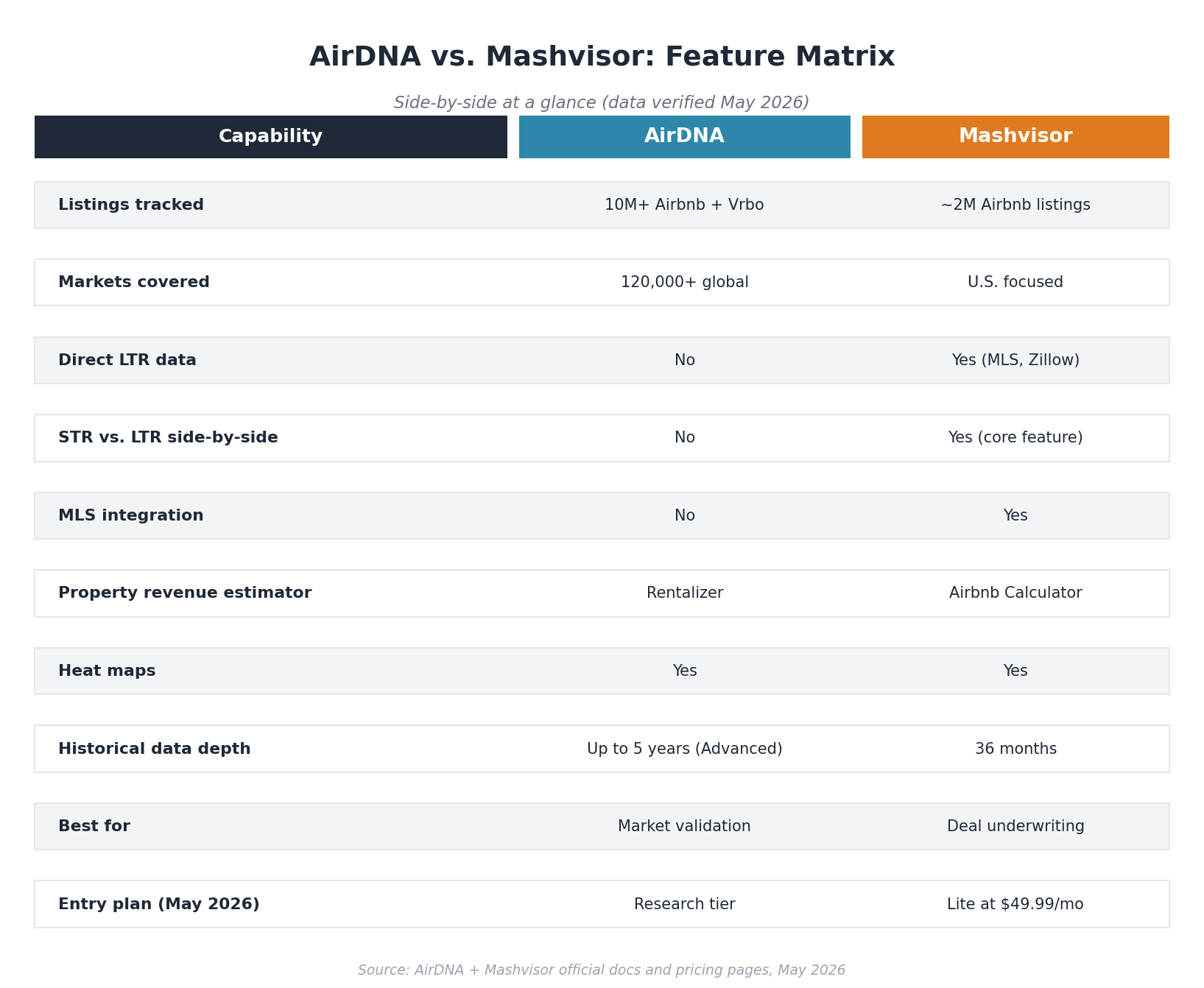
Side-by-side: the comparison table that matters
The honest feature matrix, verified against both companies’ official documentation in May 2026.
Category
AirDNA
Mashvisor
Primary data source
Scraped Airbnb + Vrbo public listings, plus partner channel manager feeds
MLS + Airbnb signals + Zillow + Census + public records
Listings tracked
10M+ Airbnb and Vrbo (official figure)
~2M Airbnb listings (official figure)
Markets covered
120,000+ markets globally
U.S. focused, nationwide coverage
Long-term rental data
None
Yes, integrated
STR vs. LTR comparison
No
Yes (core feature)
MLS integration
No
Yes, with heat maps over for-sale inventory
Property revenue estimator
Rentalizer (unlimited PDFs on paid tiers)
Airbnb Calculator (limited on Lite, unlimited on Standard+)
Pricing tools for hosts
Rate suggestions on Host tier, plus 3 Uplisting listings
Dynamic Pricing tool with auto-rate logic
Historical data depth
36 months on Research, back to 2017 on Advanced
36 months standard, up to 10 years on Enterprise
API access
Enterprise tier, custom pricing
Enterprise tier, custom pricing (raw data + bulk downloads)
Smaller STR sample, no Vrbo direct scrape, U.S. only
Pricing notes above are accurate as of May 2026 per each platform’s official pricing page. Both companies adjust tier names and pricing periodically, so verify on AirDNA’s pricing page and Mashvisor’s pricing page before subscribing.
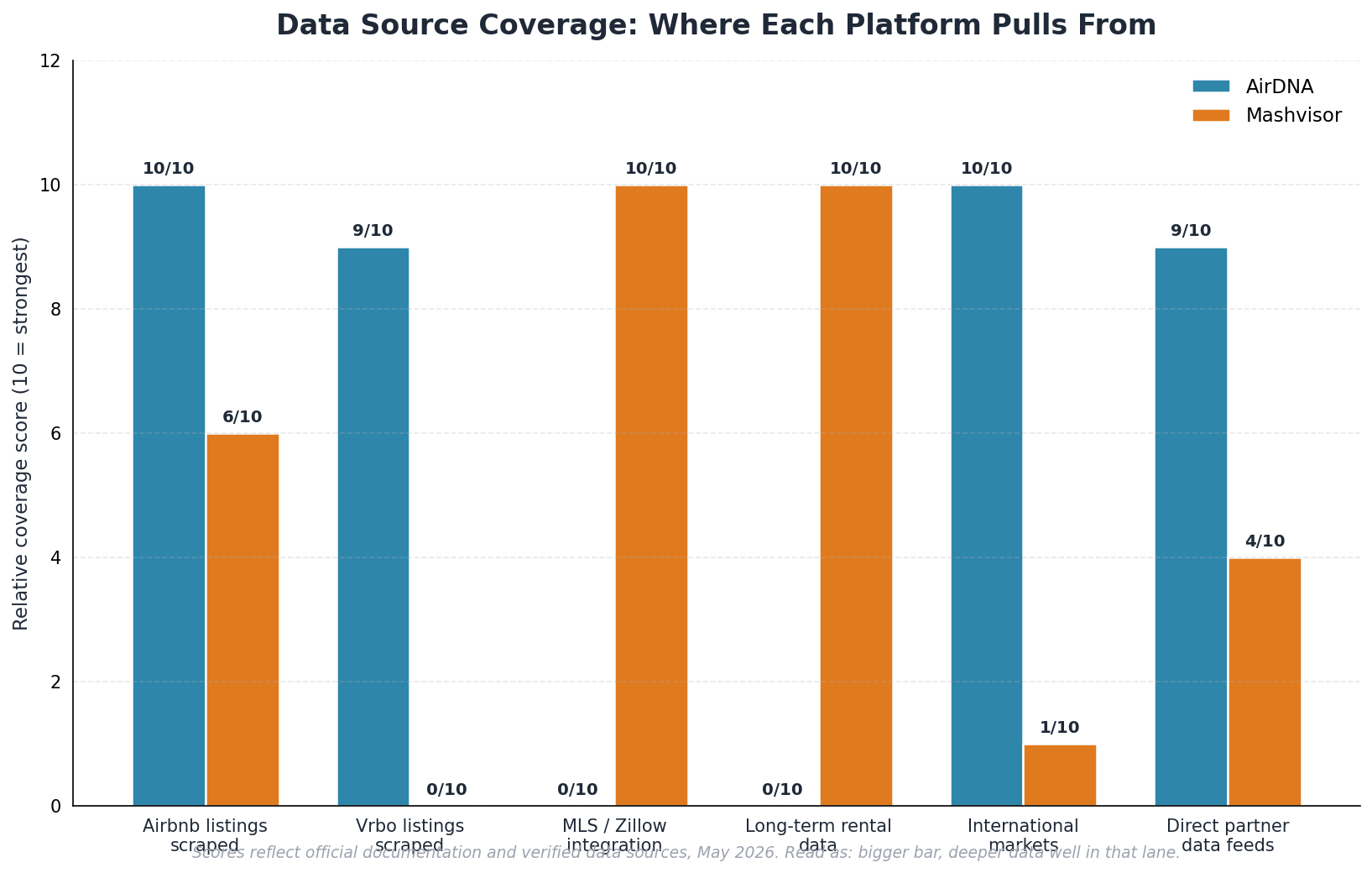
Data sources and accuracy: where the rubber meets the road
Where each platform pulls from. Bigger bar means deeper data well in that lane.
This is the section that decides which tool actually fits your workflow. Listings tracked is a vanity metric. What matters is whether the data the platform serves you reflects reality in your market.
AirDNA’s accuracy profile. Because AirDNA scrapes Airbnb and Vrbo public listing pages directly and supplements with partner channel-manager data, its occupancy and ADR numbers track the actual platforms closely in markets with high listing density. In a city like Nashville, Austin, or Orlando, where AirDNA has thousands of comps in any given ZIP, the numbers are tight. In rural markets with 30 active listings, the model gets noisy. That’s not unique to AirDNA. It’s a math problem (small sample, high variance).
The honest critique of Rentalizer (AirDNA’s address-level projector): it pulls comparable properties within a radius and averages their performance. If your prospective property has unique features the comp set doesn’t (lake view, hot tub, 12-foot ceilings, mountain access), Rentalizer underestimates. If the comp set has hidden quality the prospective property lacks, Rentalizer overestimates. Real operators treat Rentalizer as a starting estimate, then layer in their own judgment.
Mashvisor’s accuracy profile. Mashvisor’s STR numbers come from a smaller listing pool, so in dense urban markets they tend to be directionally correct but less precise than AirDNA. Where Mashvisor wins is on the long-term rental side. Because it pulls Zillow Rent Zestimate-style data and local LTR comps, its LTR projections are usable. AirDNA doesn’t even attempt this.
The pure underwriting case: you have a $385,000 condo in Tampa, mortgage payment $2,650, HOA $420. You want to know if it cash-flows as an Airbnb or as a 12-month rental. AirDNA can answer half that question. Mashvisor answers both, side by side, in the same screen. For a buy-side decision, that’s the entire reason Mashvisor exists.
Free. Global market explorer with limited results, 12 months of look-back, no Rentalizer access.
Research. Monthly or annual billing. 36-month look-back, exports, custom mapping. Entry pricing typically runs $15-40 per month per market, scaling with market size.
Host. Everything in Research, plus 3 Uplisting listings, performance benchmarking, rate suggestions, direct-booking site builder.
Advanced. Annual-only. Historical data back to 2017, up to 5 years of extended analytics.
Note: AirDNA prices by market. If you want one small city, you pay one price. If you want all of Florida, that’s a different number. The pricing page does not list flat-rate national access for individual subscribers; that’s an enterprise conversation.
Lite. $49.99 per month. Individual property analysis, ROI calculations, regulatory rule database for 500+ cities.
Standard. $74.99 per month. Adds heat maps, neighborhood discovery, STR vs. LTR comparison, 20 monthly Excel exports.
Professional. $99.99 per month. Multifamily listings for up to 3 cities, foreclosure filters, CRM, 60 exports.
Enterprise. Custom. Raw data, API access, up to 10 years of historical data, bulk downloads.
If you only need one market for one decision, AirDNA’s Research tier is cheaper. If you need national MLS plus STR/LTR comparison every month, Mashvisor’s Standard plan at $74.99 is the right move. There is no version of the math where the cheaper subscription beats the right subscription for your workflow.
Where AirDNA wins
Market validation. If you want to know whether a specific ZIP code or city is a viable Airbnb market, AirDNA gives the most granular, defensible answer. Occupancy curves by month, ADR by bedroom count, RevPAR by amenity bundle. Nothing else on the market goes that deep.
International coverage. 120,000-plus markets globally. If your strategy includes Mexico, Costa Rica, Portugal, or anywhere in Europe, Mashvisor isn’t a real option. AirDNA is.
Comp-set transparency. AirDNA lets you see the actual listings in a comp set, click into them, and verify the data with your own eyes. That sanity check is missing from most competitors.
Vrbo data. Family-travel and lake/beach markets often skew Vrbo-heavy. Mashvisor doesn’t pull Vrbo directly. AirDNA does, and the differential matters in those markets.
The data is what big buyers use. Hotel chains, institutional STR funds, and tourism agencies subscribe to AirDNA’s enterprise feeds. When you’re underwriting a deal against those buyers, you want the same data they’re using.
Where AirDNA falls short
No LTR data, ever. You can’t compare an STR scenario to a 12-month-lease scenario inside AirDNA. You have to leave the platform.
Rentalizer noise in thin markets. If your target property has fewer than 30 comparable listings within a defensible radius, Rentalizer projections start to wobble. Operators in small markets learn to manually adjust the comp set, which defeats some of the speed advantage.
Per-market pricing gets expensive fast. If you’re scouting 6 cities simultaneously, the cost stacks. There is no clean flat national-access tier for individual investors.
MarketMinder learning curve. The interface is dense. New operators sometimes misread the comp filters and end up benchmarking against the wrong cohort (e.g., comparing a luxury 4-bedroom to studio comps). That’s a user error, but the UX could prevent it more aggressively.
Where Mashvisor wins
STR vs. LTR side-by-side. The single feature that justifies the subscription for buy-side investors. Nothing else in the comparison set does it cleanly.
MLS + heat maps. You can shop for properties on the platform and see projected returns layered over for-sale inventory in real time. That’s a deal-flow accelerator, not just an analysis tool.
Easier learning curve. The interface walks first-time investors through analysis with built-in explanations. AirDNA assumes you know what RevPAR means; Mashvisor teaches you while you use it.
Regulatory rule database. Mashvisor maintains a database of STR regulations for 500+ U.S. cities. AirDNA does not publish a comparable resource. For investors avoiding regulatory landmines, this is useful.
Lower entry price for full feature access. $49.99/mo on Lite gives you national STR data. AirDNA’s equivalent flat-access tier doesn’t exist at the same price point.
Where Mashvisor falls short
Smaller STR comp pool. ~2M listings vs. AirDNA’s 10M+. In dense urban markets the gap is fine. In dense vacation markets like Gatlinburg or Destin, the comp depth matters.
No Vrbo data. Family and group-travel markets need Vrbo visibility. Mashvisor doesn’t pull it.
U.S. only. If you operate internationally, Mashvisor is not your platform.
STR estimates skew conservative. Operators frequently report that Mashvisor’s revenue projections undershoot actual performance for well-optimized listings. That’s a feature if you’re a cautious underwriter and a bug if you’re trying to model upside.
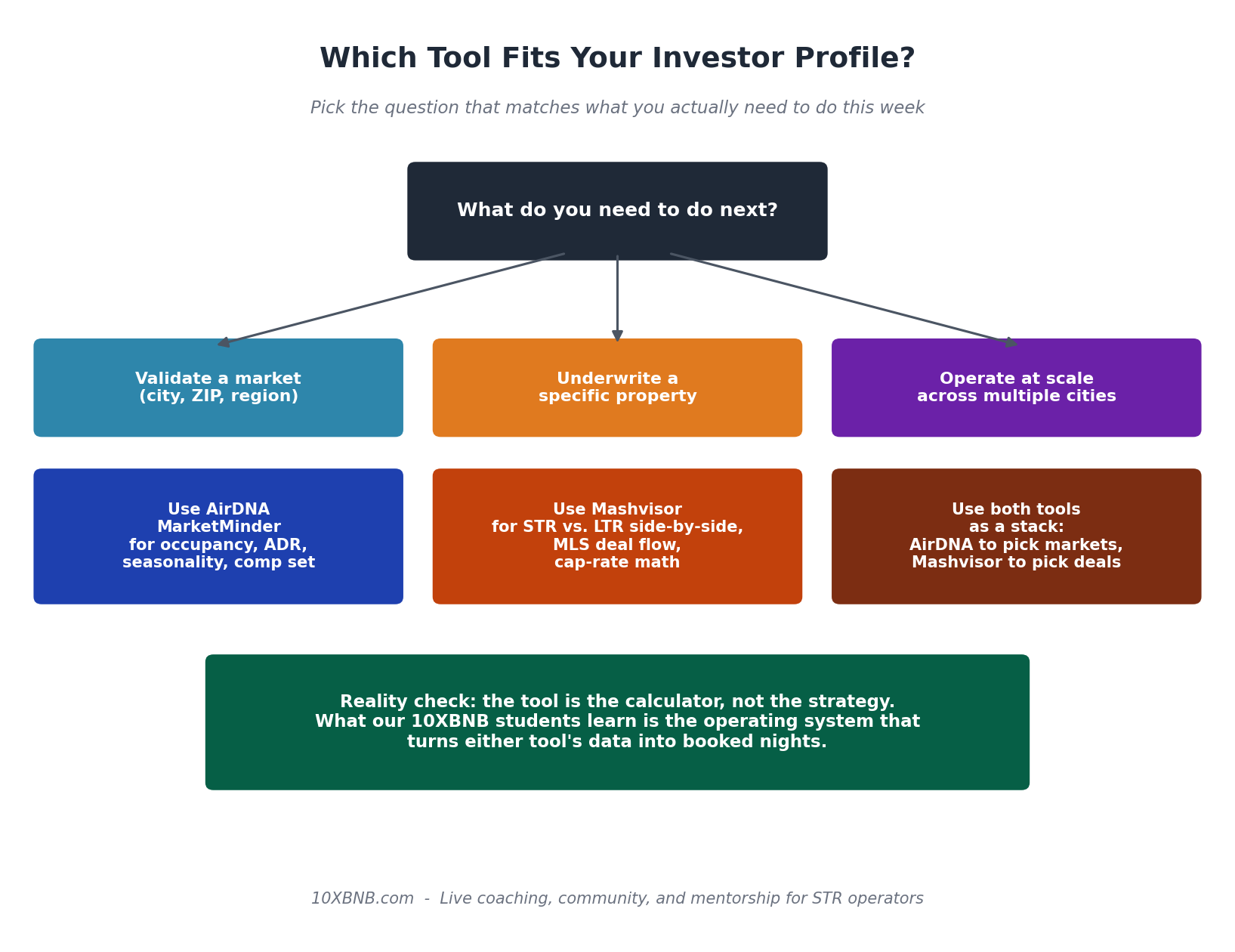
Decision tree: which one fits your investor profile?
If you don’t know which tool to start with, this decision tree is the 30-second answer.
Run yourself through the three branches:
Branch 1: You’re picking a market. Start with AirDNA. Its market-level data depth and global coverage make it the better validation tool. Once you’ve narrowed to a city or ZIP, you can pull individual property projections from Rentalizer.
Branch 2: You’re underwriting a specific deal. Use Mashvisor. The STR vs. LTR comparison and MLS integration are the workflow advantages here. AirDNA can confirm the STR side, but Mashvisor gives you both sides in one screen.
Branch 3: You’re operating at scale across many cities and want to acquire continuously. Use both. AirDNA picks the markets. Mashvisor picks the deals. The two tools stack cleanly, and the combined cost is still less than a single bad acquisition.
For arbitrage operators (you’re leasing, not buying), the LTR comparison is irrelevant. AirDNA is the cleaner choice. For pure buy-and-hold STR investors who are also weighing whether long-term tenants might be smarter for a given property, Mashvisor’s side-by-side view is the killer feature.
Alternatives worth knowing about
Tool
Strong angle
Weakness
AirROI
Free Airbnb market analytics for 190+ countries
Less granular than AirDNA at the comp-set level
Airbtics
Solid international coverage, useful for emerging markets
Smaller user base, fewer third-party integrations
Rabbu
Free Airbnb data and market browsing, U.S. focused
Light on advanced analytics, no API for free users
Key Data
Direct PMS data feeds (cleaner than scrape data)
Geared toward property managers, not individual operators
BNBCalc
Quick address-level revenue projections
Thinner than AirDNA on market-level analytics
None of these replace AirDNA or Mashvisor for serious operators. They’re useful sanity-check layers. If you ever see a Rentalizer projection that feels off, cross-checking against AirROI or Rabbu takes 90 seconds and is worth doing.
STR operators researching new markets, especially internationally.
Arbitrage operators who need accurate ADR and occupancy without LTR noise.
Property managers benchmarking their portfolio against market comps.
Real estate funds doing institutional market diligence.
Anyone running comp-set analysis against listed competitors for pricing strategy.
If you’re in any of these buckets, the Research tier pays for itself the first month, assuming you actually use it.
Who should subscribe to Mashvisor
Buy-side real estate investors comparing strategies on a specific deal.
Investors building an acquisition pipeline across multiple U.S. markets.
New investors who want a guided UX while learning underwriting.
House hackers and small landlords weighing STR conversion of an existing rental.
Investors who want regulatory-rule visibility built into the analysis screen.
Mashvisor’s Standard tier at $74.99 hits the sweet spot for most of these profiles. Lite is too light, Professional is overkill until you have 5+ active deals.
What our 10XBNB students actually do with these tools
Here’s the part nobody else writing about AirDNA vs. Mashvisor will tell you: the tool you pick almost doesn’t matter if you don’t know what to do with the data.
Inside 10XBNB, we have students running both subscriptions. We have students running neither. The student who consistently lands first-month profitability isn’t the one with the better SaaS stack. It’s the one who knows how to read a comp set, identify a market with regulatory tailwind, structure a lease that allows STR use, set up automation that books while they sleep, and price dynamically through the seasonality curve. AirDNA shows you the curve. It doesn’t teach you what to do at the top and bottom of it.
The system we teach inside 10XBNB sits around whichever data tool you pick. It includes:
Live coaching from operators with hundreds of doors under management collectively. You bring a deal, they tear it apart on a call, you walk away with a yes/no answer in 20 minutes.
An active student community where people are running the same playbooks in different markets and trading what’s working in real time, by market.
Mentorship from operators who have already made the mistakes you’re about to make and can tell you which AirDNA or Mashvisor signals to trust and which to discount in your market.
Templates, scripts, and SOPs for the operational work the data tools don’t touch. Lease negotiations. Cleaner onboarding. Pricing rule architecture. Owner outreach.
If you’ve been wrestling with which tool to pick, that’s usually a sign you don’t yet have the surrounding system that makes the data actionable. Hop on a free call with our team. We’ll show you what the system looks like, whether it fits, and (if it doesn’t) we’ll point you at the right next step regardless.
FAQ: AirDNA vs Mashvisor
Is AirDNA more accurate than Mashvisor?
For STR-specific metrics (occupancy, ADR, RevPAR, seasonality), AirDNA’s deeper listing pool and direct Airbnb + Vrbo scrape give it a precision edge in dense markets. For long-term rental and STR vs. LTR comparison, Mashvisor is the only one that even tries, because AirDNA doesn’t pull LTR data. So the accurate answer is: AirDNA is more accurate at the things AirDNA does, and Mashvisor is more accurate at the things Mashvisor uniquely does.
Can I use just the free version of either tool?
AirDNA has a real free tier with a 12-month look-back, capped results, and no Rentalizer. It’s enough for a 5-minute market sanity check. Mashvisor doesn’t have a permanent free tier, only a limited trial. For one-off market research, the free AirDNA layer plus a free tool like AirROI gets you 80% of what you need.
Which one should I pick if I’m an Airbnb arbitrage operator?
AirDNA. You’re not buying, so MLS data is irrelevant. What matters is accurate ADR and occupancy projections in the markets you’re scouting for leases. AirDNA’s deeper comp set and Vrbo coverage win on this use case. Once you’ve narrowed to a market, our Airbnb arbitrage calculator handles the lease-vs-revenue math.
Does Mashvisor work outside the United States?
No. Mashvisor is U.S. focused, with nationwide MLS, Zillow, and STR data coverage but no international market support. If you’re researching properties in Mexico, Costa Rica, Portugal, or Bali, you need AirDNA, Airbtics, or AirROI instead.
Is AirDNA’s Rentalizer worth it?
Yes for one-time property checks in dense markets. The projections are reasonable starting points. The trap is treating Rentalizer output as gospel for thin markets (under 30 comps) or unique properties. Operators who treat it as a first-pass filter, then layer in their own judgment from comp-listing photos and reviews, get the most value out of it.
How often do these platforms update their data?
AirDNA refreshes market-level data monthly and listing-level data continuously through its scrape pipeline, per the company’s published methodology. Mashvisor refreshes Airbnb and MLS data on rolling cycles, with property-level estimates updating as new transactions and listing changes flow through. Neither is real-time. For dynamic pricing decisions during peak season, you want a dedicated pricing tool sitting on top of these data feeds.
Can I just use both?
Yes, and many serious operators do. AirDNA for market selection and comp-set benchmarking, Mashvisor for buy-side deal underwriting. The combined cost is real but small compared to a single misjudged acquisition. If you’re running a multi-market acquisition strategy, the dual-tool stack is the right move.
What about the 10XBNB program (and what does it cost)?
10XBNB is the live coaching, community, and mentorship layer that goes around whichever data tool you choose. We don’t replace AirDNA or Mashvisor. We teach you how to act on what they tell you. The right next step is a free coaching call where we look at your specific situation and tell you, honestly, whether the program fits. Book the call here. No price gymnastics on the page. We’ll walk you through it on the call.
The final verdict
If forced to pick one and only one, I’d pick AirDNA. Not because it’s better at everything (it’s not), but because its core job (telling you whether a market is worth attacking) is the question most STR operators need answered most often. Mashvisor is genuinely better for buy-side underwriting, and if that’s your primary workflow, pick Mashvisor without hesitation.
The honest split:
AirDNA wins on market validation, international coverage, comp-set depth, and STR pricing strategy.
Mashvisor wins on deal underwriting, STR vs. LTR comparison, MLS integration, and acquisition pipeline workflow.
Neither tool is the strategy. Neither tool teaches you how to negotiate a rental arbitrage lease, structure a co-host agreement, build a five-listing portfolio in a regulatory-friendly market, or run dynamic pricing that captures peak-season upside. That’s the work that happens after the data tool spits out a number.
Before you spend $50 to $100 a month on either subscription, do one thing: book a free 20-minute coaching call. We’ll look at where you are, what you’re trying to build, and tell you which tool actually fits. If neither does, we’ll say that too. No price pitches on the page. Just the right answer for your situation.
Hospitable, the platform formerly known as Smartbnb and Your Porter,
has become the default property management platform for operators between one and fifty
listings. The reason most operators land on it is the guest communication automation.
The AI auto-reply, message templates, and review automation handle the parts of the
business that eat the most time.
An honest review acknowledges both sides. Hospitable wins on intuitive interface,
strong AI message handling, and pricing that scales linearly with listing count. It loses
on channel manager depth (Hostaway has more direct integrations) and financial reporting
(Stessa or Hostfully Books handle that side better). The full
Hospitable review for Airbnb operators walks through the AI auto-reply system in
detail, which is what makes Hospitable different from Hostaway or Guesty.
Pair the platform with the rest of the operator stack. The
Airbnb automation tools covers what a complete automation system
looks like for an Airbnb business at different portfolio sizes.
10XBNB students who run Hospitable use it as the guest-comm layer inside a larger
operator system. Live coaching teaches the message-trigger logic, the active community
shares the templates that actually convert reviews into bookings, and mentorship from
operators with about a thousand collective doors shapes the automation around real
patterns rather than guesses. The tool handles the messaging. The system handles the
business.
If you are about to write the check for a dynamic pricing tool, the
three names you keep hearing are Pricelabs, Wheelhouse, and Beyond. They are not
interchangeable. The right pick depends on portfolio size, market volatility, and how
much rule-writing you want to do.
Quick frame. Pricelabs is the data-deep default for most operators between two and
fifty listings, with the deepest comp sets and the finest rule engine. Wheelhouse leans
on machine learning and works well in volatile markets at mid-portfolio scale, though the
percentage fee model bites at higher revenue. Beyond is the simplest tool for one to three
listings in stable markets, and the simplest one to outgrow.
Our full Pricelabs vs Wheelhouse vs Beyond Pricing comparison runs the side-by-side table on
features, pricing models, integrations, learning curve, and the operator profiles each
tool actually fits. We refuse to crown a single winner because the answer is a matrix.
One thing all three tools share is that they price your existing nights. They do not
help you pick the right market, write the right landlord script, or build the operations
that keep one operator running multiple units. Run the numbers on a deal yourself in the
Airbnb arbitrage calculator and you will see what the tool can and cannot
do for you.
The 10XBNB program is positioned as the layer above the tool. Live coaching, the
active student community, and mentorship from operators with collectively about a
thousand doors. The tool is necessary. The operator system is what produces the lift.
More tool reviews and operator deep dives at the 10XBNB blog.
Beyond Pricing, now just Beyond, was the first dynamic pricing tool that
mattered in vacation rentals. From 2013 to 2020 it was the default pick. The category has
moved past it in some ways, but Beyond still serves a specific operator profile well.
Who that profile is, exactly, is what most reviews skip. Beyond is the right pick for
hands-off operators with one to three listings in established markets, where set-and-forget
is the goal and the percentage fee on smaller revenue stays manageable. Once your monthly
revenue per listing crosses about two thousand dollars, the percentage model starts to
cost more than flat-fee competitors charge for the year.
Our full Beyond Pricing review runs that math and lays out where
Beyond still wins, where it has lost ground to Pricelabs, and the channel-sync features
that did stay competitive (Relay covers Airbnb, Vrbo, and Booking.com). For the broader
operator stack, the Airbnb tools roundup covers the full set of
tools 10XBNB students typically run.
The honest message we give students is simple. Pick the tool that fits your scale.
Beyond is fine for the first one or two units. The day you hit five units the math points
elsewhere, and the live coaching, active student community, and mentorship from operators
who have made the same migration is what makes the switch smooth.
Wheelhouse positions itself on machine learning sophistication. The
question is whether the ML actually wins for your portfolio, because the pricing model
charges a percentage of booking revenue at the Pro tier, and that math gets expensive at
scale.
Here is the real picture. Wheelhouse shines for operators with five to fifteen mid
priced listings in markets with real volatility. The ML reads pickup pace and event-driven
demand faster than rule-based engines, and the dashboard helps you spot pricing mistakes
in days, not weeks. For a single listing or a stable market, simpler tools usually do the
job for less money.
The full operator-honest Wheelhouse review runs pricing math at five revenue
tiers and exposes where Wheelhouse Pro Flex quietly costs four to six times Pro Flat at
the wrong portfolio. That is the kind of detail most reviews skip, because the math
embarrasses the tool at certain price points.
If you want to see Wheelhouse next to its two main competitors, the
Pricelabs vs Wheelhouse vs Beyond Pricing covers all three with a portfolio-aware verdict
chart instead of a forced winner.
10XBNB students who use Wheelhouse usually pair it with the rules we teach inside the
program. The tool sets the daily number. The operator decides the base, the floor, the
weekday-vs-weekend split, and the orphan-day rule. Live coaching, the active community,
and mentorship from operators running these systems at scale make the configuration
actually work.
Pick the pricing tool that matches your portfolio size. More operator reviews at the
10XBNB blog.
Pricelabs sits in the operator stack of most short-term rental businesses
running more than two units. The tool is widely used and widely reviewed, but the reviews
fall into two patterns. Either they are affiliate pieces that gloss over real friction, or
they are venting threads that skip the actual mechanics.
Here is what an honest read looks like. Pricelabs has the deepest data of the three
major dynamic pricing engines. It tracks comp sets and pickup pace across millions of
listings, and the rule engine gives you finer control than Wheelhouse or Beyond. The flip
side is a learning curve. New operators often misconfigure base prices and minimum stays
on day one, then blame the tool for low occupancy.
Read the full honest Pricelabs review for the algorithm walkthrough,
the pricing tier math, and the configurations that actually move revenue. We also lay out
where Pricelabs falls short, including the occasional algorithmic dip during shoulder
seasons and the dated bits of the interface.
If you are still deciding between platforms, the dynamic pricing tools comparison
walks through the head to head with Wheelhouse and Beyond. The right answer depends on
portfolio size, market type, and how much rule-writing you want to do.
The piece our 10XBNB students always come back to is the operator system around the
tool. Pricelabs picks the right number on a given night. It does not pick the right base
price for the season, set your minimum stay for the right traveler, or handle the
landlord conversation that gets you the unit in the first place. That is what live
coaching, the active student community, and mentorship from operators with collectively
about a thousand doors actually provides.
Pick the tool that fits your portfolio. Then layer the system that turns the tool into
real revenue. More operator deep dives at the 10XBNB blog.
If you are new to Airbnb arbitrage, the first 90 days decide more than
anything that comes later. Here is what that window looks like when it goes well.
Weeks one and two are research, not action. You pick a market by reading three numbers:
average daily rate, occupancy, and the spread between busy and slow months. You confirm the
short-term rental rules for that city, because local law, not state law, decides whether
you can operate. Skipping this step is the mistake that ends beginner runs early.
Weeks three and four are the lease. You approach landlords with a clear pitch: reliable
monthly rent, professional care of the unit, and a written short-term rental addendum.
Expect to hear no several times before you hear yes. The contract is your protection, so it
gets signed in writing with the platforms and the entity named. New operators often
underestimate the cash needed at this stage, so the
rental arbitrage startup costs guide is worth reading before you commit.
Weeks five and six are setup. Furniture, basic decor, and the items guests actually
rate: a good mattress, a comfortable sofa, and a kitchen that works. You book a
professional photographer, because listing photos drive booking speed more than any clever
description.
Weeks seven and eight are launch. The listing goes live with a strong title, a clear
description, and a dynamic pricing tool set to adjust rates daily. First-month occupancy
usually runs lower than the spreadsheet promised, somewhere near 30 to 40 percent, so your
reserve has to cover that slow start. This is normal. It is not a sign the unit failed.
Weeks nine through twelve are tuning. You watch which nights book and which sit, adjust
the minimum stay, refine the photos that underperform, and tighten your cleaner schedule.
By day 90 a well-run unit is settling into a steady booking rhythm.
The honest part: the first unit is the hardest, because every step is new. A clear plan
removes most of the fear. A walkthrough of the whole beginner path is in this guide to
Airbnb arbitrage for beginners, written for people taking their first step.
This is also where many beginners decide they want guidance rather than a solo run. That
is a reasonable call. 10XBNB built its program for first-time operators who want a proven
plan and people to ask along the way.
More starter guides are at the 10XBNB blog. Momentum beats
perfection. Get the research right, take the first lease, and learn from the real unit.
There are more Airbnb arbitrage courses than ever, and they are not equal.
Before you enroll in any of them, it helps to have a clear set of filters. Here is the
checklist I use.
First, check whether the teacher is an active operator. The market changed in the last
two years. Platform fees, regulations, and pricing tools all moved. A course built by
someone who left the business in 2022 teaches a model that no longer matches reality. An
active operator updates the material because they live in it.
Second, look at the curriculum depth. A real program covers market selection, landlord
negotiation, lease structure, listing optimization, pricing, and the operating systems for
guest management. A course that spends all its time on the exciting parts and skips the
lease and the systems is not teaching the whole business. If you are still deciding whether
the model fits you, start with what Airbnb arbitrage actually is.
Third, check the support format. A pure video library leaves you alone the moment a real
problem appears. Programs with live coaching and an active community help you when your
specific landlord or your specific listing needs an answer. That difference shows up in how
fast you reach a profitable unit.
Fourth, look for an honest refund policy and real student outcomes. A program confident
in its material states its terms clearly and points to operators it has actually helped.
Fifth, judge the content currency. Ask when the modules were last updated. The 2026
version of arbitrage is not the 2023 version, and the material should show it.
We applied exactly these filters in our roundup of the
best Airbnb arbitrage courses compared, scoring each option on curriculum, format,
support, and who it actually suits. 10XBNB ranks at the top of that list, and the roundup
is honest about why, with fair treatment of the alternatives.
One caution worth stating. The flashiest marketing does not equal the best teaching, and
a low sticker does not equal a bargain. The right program is the one whose teaching depth
and support format match how you learn and how fast you want to move.
The honest way to judge any course is against your first deal. A program that gets you
to a profitable lease sooner, and helps you avoid one costly mistake, has earned its place.
Match the format to your situation and decide from there.
More operator guides are at the 10XBNB blog. Compare on
substance, enroll with clear eyes, and then do the work.
Plenty of people run one Airbnb arbitrage unit. Far fewer run five. The
difference is rarely talent or capital. It is training, specifically training in systems.
A first unit can be run on effort alone. You answer every message yourself, you handle
every cleaner call, you adjust pricing by hand. It works because there is only one of
everything. The model breaks at unit two or three, when effort runs out of hours.
This is what structured training fixes. Good structured Airbnb arbitrage training
does not just teach you to launch a unit. It teaches you to build the operating system that
lets the second and third unit run on the same effort as the first. Standard messaging
templates, a repeatable cleaner checklist, a pricing tool set once and trusted, and a clear
weekly routine.
The curriculum that matters covers a few clear stages. Market research and deal sourcing
first, so you sign good leases. Landlord negotiation and lease structure next, so the
contract protects you. Listing setup, photography, and pricing after that, so the unit
earns. Then guest operations and the systems that make the work repeatable. A program that
teaches the launch but skips the systems leaves you stuck at one unit.
Training also shortens the timeline to your first signed lease. A new operator working
alone often spends a month deciding on a market and a lease structure. A trained operator
moves through those decisions in days, because the framework is already in hand. If you are
at the very start, the how to start an Airbnb business guide lays out the order
of operations.
The other thing training gives you is judgment about what to skip. Beginners waste money
on the wrong things: fancy decor, premium furniture, gadgets guests never notice. Trained
operators spend on the mattress, the listing photos, and the pricing tool, and they skip
the rest. That discipline protects margin on every unit.
10XBNB built its training around the full operator path, from the first market decision
to the systems that support a small portfolio. It pairs the modules with live coaching, so
the framework meets your real situation.
One honest point. Training does not promise income. It teaches a model and the skills to
run it. The numbers depend on your market, your lease, and your execution. What training
reliably does is remove the avoidable mistakes and compress the learning curve.
More operator resources are at the 10XBNB blog. Learn the
systems first, and the second unit becomes a decision rather than a leap.
A video course and a coaching program solve different problems. The course
gives you the map. Coaching helps you when the map and the real road stop matching, which
happens fast in Airbnb arbitrage.
Here is the pattern I see. A new operator buys a self-paced course, watches the modules,
and feels ready. Then a landlord asks a question the videos did not cover. Or a listing
sits at low occupancy and the operator cannot tell whether the problem is price, photos, or
the market. A recorded lesson cannot answer a question it was not built for. A coach can.
That is the case for one-on-one Airbnb arbitrage coaching. Live feedback on your
actual deal, your actual numbers, and your actual city beats general advice every time. A
coach who is an active operator has usually seen your exact situation in the last month.
Coaching also fixes the speed problem. Left alone, a beginner can spend weeks stuck on
one decision: which market, which lease, which pricing tool. A coaching call collapses that
into one conversation. The time saved is the real return, because every week you are not
operating is a week of rent you could have been earning against.
There is a confidence factor too. Arbitrage asks you to sign a lease and take on a real
monthly obligation. That is a hard step to take alone. Knowing a coach has reviewed the
deal before you commit removes the second-guessing that stops people from ever starting.
Not every coaching setup is equal. Look for three things. The coach should be an active
operator, not someone who left the business years ago. The format should include direct
access, whether that is live calls or a fast response channel. And the program should have
a community, because peer operators catch things a single coach misses. Compare the
Airbnb coaching options with those filters in mind.
10XBNB built its program around live coaching and an operator community for exactly
these reasons. The teaching is current, the feedback is specific, and you are not solving
problems alone.
One honest note. Coaching rewards people who show up and do the work between calls. If
you want someone to run the business for you, that is management, not coaching. If you want
to learn fast and avoid the expensive mistakes, this is the format that delivers.
More guides for operators are at the 10XBNB blog. The right
support turns a slow, uncertain start into a fast, confident one.
People ask me whether an Airbnb arbitrage course is worth it. The better
question is what the course actually teaches, because the gap between a useful program
and a thin one is wide.
Start with market selection. Any course that skips this is selling theory. A strong
program teaches you to read three numbers on every market: average daily rate, occupancy,
and the gap between peak and slow months. Sign a lease in the wrong city and no amount of
pricing skill will rescue the unit.
Next is the landlord conversation. This is where most beginners freeze. A good course
hands you the exact language for a short-term rental addendum, the objections landlords
raise, and the answers that get a signature. The 10XBNB program covers this in its
Airbnb arbitrage course curriculum, with scripts for apartment buildings and
single-family owners.
Then there is the money math. You want a course that makes you run real numbers before
you commit: rent, furniture, utilities, cleaning, the platform fee, insurance, and a
maintenance reserve. A unit that looks profitable on a napkin often turns breakeven once
those costs land. Learn the full model from the rental arbitrage guide
before you sign anything.
Listing and pricing come next. Photography, title and description writing, and dynamic
pricing tools each move bookings in measurable ways. A course should show you how to set a
base price and let a tool adjust daily, because manual pricing leaves real revenue on the
table.
Operations is the part that separates a hobby from a business. Cleaner scheduling, guest
messaging, restocking, and the systems that let one person run several units without
burning out. This is also where live support matters, because operational problems show up
fast and a recorded video cannot answer your specific question.
That is the real test of a course. A video library teaches the concepts. A program with
live coaching, an active community, and mentorship helps you when your actual landlord
pushes back or your actual listing stalls. 10XBNB built its training around live calls and
operator support for that reason.
One honest caution. No course removes the work. It shortens the path, it prevents
expensive mistakes, and it gives you people to ask. The execution is still yours.
If you are weighing your options, read more operator guides at the
10XBNB blog. Pick the program that teaches the whole business,
not just the exciting parts.
Airbnb arbitrage training is structured instruction that teaches you the rent-to-rent model: how to lease a property from a landlord, get written permission to sublet it on Airbnb, furnish it, and run it as a short-term rental for profit, all without buying real estate. A complete arbitrage training program walks you through market analysis, landlord outreach, lease negotiation, listing optimization, dynamic pricing, automation, and day-to-day operations. With consistent action, most students who follow a structured program sign their first arbitrage lease within 30 to 60 days. This guide breaks down exactly what that training covers, the skills you build, the formats available, the realistic timeline, and what it costs.
If you want a coaching-led path with live calls, a module library, and a community of active operators, the 10XBNB program details page shows the full curriculum. The rest of this article explains what to expect from arbitrage training in general so you can choose well.
What Airbnb rental arbitrage training is
Airbnb rental arbitrage means you rent a property on a standard long-term lease, get the landlord’s written permission to sublet, and then list that Airbnb rental as a short-term rental. You never buy the property. Your profit as an Airbnb host is the spread between what you pay each month (rent plus utilities, furnishing amortization, cleaning, and software) and what you collect in nightly booking revenue. Airbnb arbitrage works as a small Airbnb business that turns a long lease into nightly income, and arbitrage opportunities open up wherever rent stays low and nightly demand runs high. Rental arbitrage appeals to people who want a short term rental business without the cost of buying property, and arbitrage training is what makes that path repeatable instead of a gamble. The rental arbitrage model has built full-time incomes for operators who learned it properly, and it has also lost money for those who skipped the fundamentals. The difference is rarely the market. It is whether the operator was trained before they signed a lease.
Airbnb arbitrage training compresses the learning curve for that model. Instead of guessing your way through your first landlord call or your first Airbnb listing, you follow a sequence that thousands of short-term rental operators have used: pick a market, underwrite a deal, pitch a landlord, sign a lease that authorizes short-term rental, furnish the property, build the listing, and price it for guests. A good course gives you the scripts, contract language, and pricing logic so you skip the expensive mistakes that catch most new operators. For a fuller primer on the model itself, see what Airbnb arbitrage is and the deeper breakdown of how rental arbitrage works.
The short term rental industry, often shortened to STR, treats arbitrage as one of the lowest-capital ways into the business. You are not buying a property, so you skip the down payment and the mortgage. You are renting one, furnishing it, and operating it as a short term rental on Airbnb. That lower barrier is exactly why structured training matters: a low-capital entry attracts beginners, and beginners without training make costly mistakes on market choice, pricing, and lease terms. A course turns the low barrier into a real advantage instead of a trap, because it teaches you to find good properties, win bookings, and keep guests rating you highly.
How rental arbitrage makes money
Here is the math, laid out so you can check it. Say you lease a furnished-ready two-bedroom apartment for $1,800 per month. Add $250 in utilities and internet, $300 in cleaning costs across the month, and $50 for pricing and messaging software. Your monthly operating cost is $2,400. If that unit books 20 nights at an average rate of $190 per night, you collect $3,800. Subtract the $2,400 in costs and you net $1,400 for the month from one property. Run the same math across several units and you see why operators treat arbitrage as a scalable business rather than a side gig. Training exists to make those numbers reliable instead of lucky. You can model your own numbers with the Airbnb arbitrage calculator.
That spread is also why every module in an arbitrage course points back to one of two levers: lowering your monthly cost or raising your booking revenue. Market analysis protects the rent side by keeping you out of cities where regulation or oversupply crushes rates. Lease negotiation protects the cost side by reducing your deposit and securing a longer term. Listing optimization and dynamic pricing pull the revenue side up. Automation protects your time so the margin is worth earning. When you understand that the whole business is one subtraction problem, the curriculum stops feeling like a pile of unrelated lessons and starts reading as a single system. A self-taught operator usually learns this after a unit underperforms for three months. Training teaches it before you sign anything.
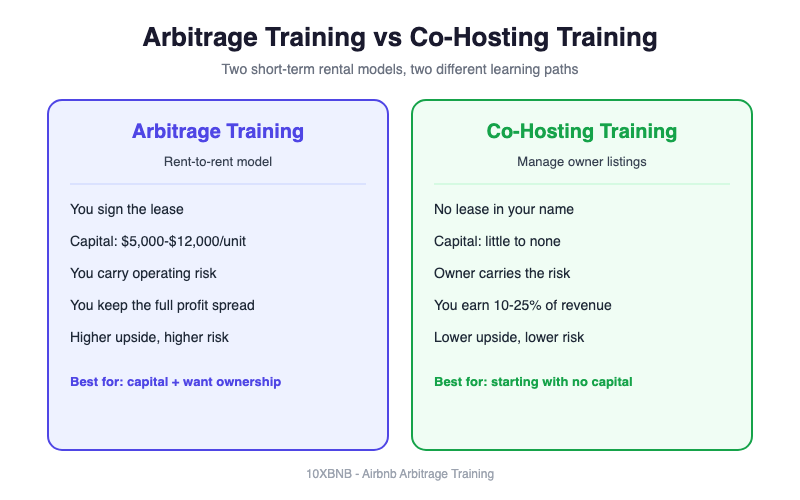
Arbitrage training versus co-hosting training
Two short-term rental business models get taught side by side, and beginners often confuse them. They need different training.
Arbitrage training teaches the rent-to-rent model covered in this article. You sign the lease, you put up the startup capital, you carry the operating risk, and you keep the full spread as profit. It rewards people who can fund a unit and want to own the upside.
Co-hosting training teaches you to manage someone else’s property listing for a percentage of revenue, usually 10 to 25 percent. You sign no lease and you front little or no capital, so it is the lower-risk entry point. If you do not have arbitrage startup capital yet, the Airbnb co-host training path is the model to study first. Many operators start with co-hosting to build cash and skills, then move into arbitrage.
Arbitrage training and co-hosting training prepare you for two different short-term rental models.
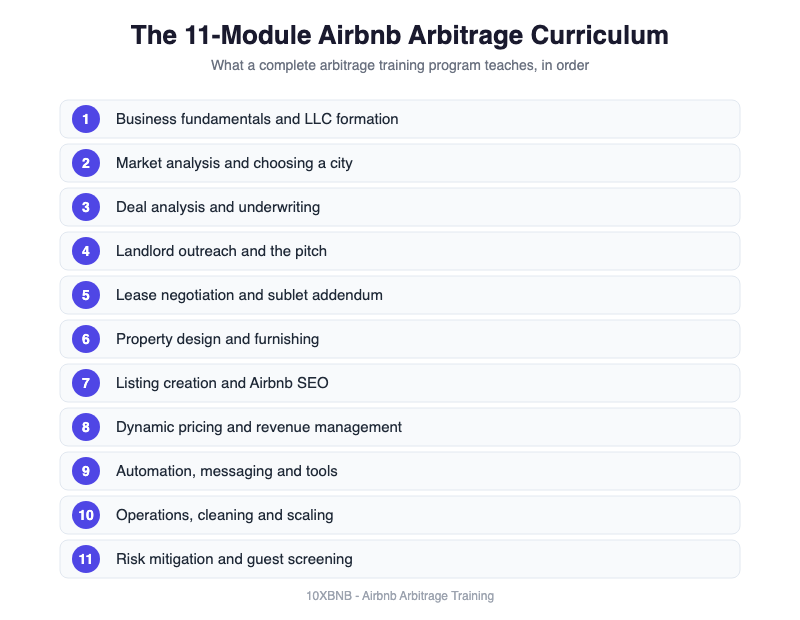
What a complete Airbnb arbitrage course covers, module by module
A serious Airbnb arbitrage course is not a single video. An Airbnb course at this level is a sequence of modules, each one a skill you need before the next step makes sense. Here is the standard curriculum that a strong arbitrage course follows, in the order most programs teach it.
The standard 11-module arbitrage curriculum, taught in sequence so each skill builds on the last.
1. Airbnb business fundamentals and LLC formation
You set up the entity, business banking, and basic insurance before you sign anything. Landlords take you more seriously when you present a registered business rather than a personal name, and an LLC keeps your arbitrage operation separate from your personal finances.
2. Market analysis and choosing a city
This module teaches you to read a market: short-term rental regulations, seasonal demand, average daily rates, occupancy rates, and competitive density. Picking the wrong city is the most expensive beginner mistake, because regulations can shut a unit down after you have already furnished it. Training shows you how to confirm a market is both legal and profitable before you commit.
A good market module gives you a checklist rather than a hunch. You confirm the city allows short-term rentals and check whether a permit is required. You look at how many active Airbnb listings already compete in the neighborhood and whether their occupancy, ratings, and rates leave room for one more property. You study the demand calendar, because a market that books solid in summer and empties in winter needs a different underwriting model than a steady year-round market. You also check what guests in that city actually want, since a property aimed at business travelers serves a different guest than one aimed at families or weekend tourists. Operators who skip this module tend to chase the first apartment they can afford. Operators who use it walk into landlord calls already knowing the property can clear a profit in that market.
3. Deal analysis and underwriting
Before you pitch a landlord, you run the numbers on the specific unit: projected revenue against rent and operating costs. This module teaches you to underwrite a deal so you only chase properties that clear a real profit margin. The arbitrage calculator is the tool you use here.
Underwriting is the skill that separates an operator from a hobbyist. You pull comparable Airbnb listings in the building or block, estimate a realistic occupancy rate and average nightly rate for that property type, and stack projected revenue against rent, utilities, furnishing amortized over the lease, cleaning, and software. If the unit does not clear a margin you are comfortable with, you walk away before you have spent a dollar. Training teaches you the threshold to require and the data sources to trust, so deal analysis becomes a five-minute habit instead of a guess you regret later.
4. Landlord outreach and the pitch
You learn where to find landlords open to short-term rental, how to contact them at volume, and how to present the arrangement as a benefit: guaranteed rent, professional upkeep, and no tenant-turnover gaps. Outreach volume is the single biggest variable in how fast you sign your first deal, so this module is heavy on scripts and tracking.
The pitch reframes the deal from the landlord’s side of the table. A landlord hears “Airbnb” and worries about wear, noise, and liability. Your pitch answers each concern before it is raised: rent paid on time every month, a professionally cleaned and maintained unit, insurance in place, and a single accountable business as the tenant rather than a rotating set of strangers. Training gives you the exact language, the channels that produce open-minded landlords, and a tracking system so you know your real numbers, how many landlords contacted, how many replied, and how many moved to a lease conversation.
5. Lease negotiation and the sublet addendum
This is the module that protects you. You learn to negotiate a longer lease term, push for a reduced security deposit by presenting a business portfolio, and, most important, get a written lease addendum that explicitly authorizes short-term rental. Operating without that written permission is the fastest way to lose a unit. Airbnb itself is clear that hosts must comply with their lease and that some leases restrict subletting, which is covered in the Airbnb short-term rental regulations help article.
6. Property design and furnishing on a budget
Furnishing decides your nightly rate and your reviews. This module covers how to furnish a property so it photographs well and feels premium without overspending, which amenities actually drive five-star guest ratings, and how to source furniture efficiently. The goal is a short term rental that guests rate highly, because high ratings raise both your Airbnb search rank and the price guests will pay. A well-furnished property is the foundation every other module builds on.
7. Listing creation and Airbnb SEO
You learn to write a title and description that rank in Airbnb search, structure your photos, and set up the listing so the platform’s algorithm surfaces it. A great unit with a weak listing sits empty, so this module treats the listing as a search asset, not an afterthought.
Airbnb ranks listings the way a search engine ranks pages. Your title, your photo order, your response rate, your review score, and your pricing all feed how high your property appears when a guest searches your city. This module teaches the order photos should run, how to write a title that includes the terms guests actually search, which amenities to list because guests filter on them, and how a fast response rate and strong early ratings push a new short term rental listing up the results. An Airbnb host who treats the listing as marketing, not paperwork, gets the property booked faster and at a higher rate than the identical unit listed carelessly down the hall. Strong guest ratings then compound: the better your reviews, the higher Airbnb ranks you, the more bookings you win.
8. Dynamic pricing and revenue management
Flat pricing leaves money on the table. This module covers dynamic pricing tools, how to price for seasonality and local events, and how to set minimum-stay rules so you maximize revenue per available night rather than just chasing occupancy. Pricing is the single skill that most directly moves your income, which is why a strong course gives it a full module.
Revenue management is where many beginners undersell. They set one nightly rate, leave it, and either sit empty because the pricing is too high for a slow Tuesday or sell out cheap during a sold-out event weekend. Dynamic pricing tools adjust your rate daily against demand, local events, and competitor pricing. The module also covers minimum-stay rules, which protect you from costly one-night turnovers, and length-of-stay discounts that fill the calendar in slower stretches. The goal of pricing is the highest revenue per available night across the whole month, not the highest occupancy and not the highest single rate. Get the pricing right and a property that was breaking even starts making money; get it wrong and the best property in the city underperforms.
Pricing also interacts with your ratings. A property priced too high for its quality collects disappointed guests and weak reviews; priced correctly, it collects happy guests and strong ratings, which raises your Airbnb rank and lets you charge more over time. Training teaches you to set pricing as part of a feedback loop, not as a number you guess once.
9. Automation, messaging, and tools
Once a unit runs, automation keeps it from eating your time. You set up automated guest messaging, smart locks, and pricing software so each property runs with minimal daily input. This module is what makes the business scalable.
10. Operations, cleaning, and scaling to multiple units
You learn to build a cleaning and maintenance system, hire and manage cleaners, and standardize operations so adding a second, third, or fifth unit does not multiply your workload. Scaling operations cleanly is the difference between a job and a business.
Here is why the scaling module matters in numbers. Using the earlier example of $1,400 net profit per unit, one property is a modest side income. Three properties run on the same systems is $4,200 a month. Five is $7,000. The work does not grow at the same rate, because the cleaning checklist, the messaging templates, the pricing tool, and the landlord pitch are built once and reused on every unit. That is the compounding advantage of arbitrage: the second deal is faster than the first, and the fifth is faster than the third, because the operator has turned each step into a repeatable process. Training front-loads that systems thinking so you are not rebuilding operations every time you add a property.
11. Risk mitigation and guest screening
The final module covers guest screening, security deposits, noise monitoring, insurance, and how to handle problem bookings, so a single bad guest does not threaten the unit or your relationship with the landlord. A trained Airbnb host treats risk as a system, not a worry: clear house rules, screening before a booking is confirmed, and a documented process for the rare problem stay.
Skills an Airbnb host builds in arbitrage training
Strip away the module names and arbitrage training builds six core skills. You can underwrite a deal, meaning you can tell a profitable unit from a money-loser before you commit. You can negotiate a lease and secure written sublet permission. You can write and run a landlord pitch at volume. You can build and optimize an Airbnb listing for search. You can set dynamic nightly pricing. And you can automate guest communication and operations so the unit runs without you watching it. Those skills transfer to every property you take on, which is why structured training pays back across your whole portfolio, not just your first deal.
It is worth being clear about what arbitrage training does not do. It does not hand you a property, it does not provide the startup capital, and it does not contact landlords for you. The work is yours. What training removes is the guessing: which market, which lease terms, which listing structure, which price. A beginner who skips training still learns all six skills eventually, but learns them slowly and expensively, one mistake at a time. The point of a structured program is to move the learning to before the money is at risk rather than after. That is the entire value proposition, and it is why the rest of this guide focuses on choosing a program that actually delivers feedback rather than just videos.
Training formats: self-paced, coaching, and mentorship
Arbitrage training comes in three formats, and the best programs combine all three.
Self-paced video modules let you work through the curriculum on your own schedule. Most students finish the core modules in four to six weeks. The strength of this format is that you can move fast through what you know and slow down on weak spots.
Live coaching calls give you a place to ask questions in real time, get your specific landlord pitch reviewed, and work through a deal you are evaluating right now. Coaching is what turns module knowledge into a signed lease. If live support matters to you, look at how Airbnb coaching and a structured arbitrage mentorship work alongside the modules.
Community and accountability come from a private group of operators at every stage. You see real deals being closed, get answers between coaching calls, and stay accountable to action. For most beginners, the community is where the model stops feeling theoretical.
How long until your first arbitrage deal
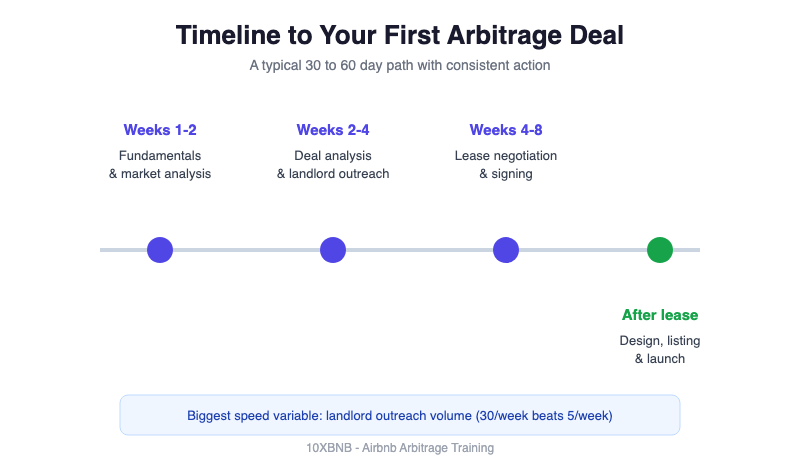
The honest answer: most students who take consistent action sign their first arbitrage lease within 30 to 60 days. The timeline depends on three things, and training is built to shorten all three. Here is the typical path.
A realistic week-by-week path from starting your training to launching your first arbitrage unit.
Weeks one to two cover business fundamentals and market analysis. You set up your entity and choose a legal, profitable city.
Weeks two to four cover deal analysis and landlord outreach. You start underwriting units and contacting landlords. Outreach volume drives speed here. An operator contacting 30 landlords a week signs a lease far faster than one contacting five.
Weeks four to eight cover lease negotiation and signing. You take interested landlords through the pitch, negotiate terms, and get the sublet addendum in writing.
After the lease, you move into design, listing creation, and launch, usually two to four more weeks before the unit takes its first booking. If you are mapping out the full path from zero, the guide on how to start an Airbnb business covers the surrounding steps.
The variables that move your timeline are market choice, how many landlords you contact per week, and whether your pitch and paperwork are ready before you start calling. Good training gets all three dialed in early.
A realistic expectation matters here. Some operators sign a lease in three weeks because they live in a strong market, contact landlords aggressively, and walk in with a polished pitch. Others take the full 60 days or a little longer because they are working part time around a job or had to test two markets before one cleared. Neither is a failure. The timeline that should worry you is the one with no end, the operator who spends six months consuming free content and never makes a single landlord call. Structured training fixes that by giving you a sequence with a clear next action at every stage, so progress never stalls on indecision.
How much Airbnb arbitrage training costs
Arbitrage training spans a wide price range, and price roughly tracks the level of support.
Free content. YouTube has hours of free arbitrage lease training. It is useful for understanding the model, but free content is scattered, often outdated, and gives you no scripts, contracts, or feedback.
Budget courses. Udemy arbitrage courses run roughly $15 to $56 and are frequently discounted. They cover the basics well but stop short of current landlord scripts, lease language, and live support.
Mid-tier programs. Most serious standalone courses sit between roughly $800 and $3,000. BNB Formula, the long-running program from Brian Page, is one example at this tier, and BNB Formula is often the first paid course beginners hear about. Active operators such as Sean Rakidzich also publish course catalogs in this range. At this tier you get a full curriculum and templates, with coaching and community varying by program.
Premium mentorship programs. Coaching-led programs with live calls, an active community, and ongoing mentorship sit at the premium end of the market. You can compare the full landscape in this breakdown of the best rental arbitrage course options, and see specific numbers on the 10XBNB pricing page.
Separate from training, budget for startup capital. Furnishing a unit, the security deposit, and first month’s rent typically run $5,000 to $12,000 per property depending on market and property type. That capital is what you actually invest in the business; the course is what makes the investment pay off.
Is Airbnb arbitrage training worth it
Training is worth it when it shortens your path to a profitable unit by more than it costs. Run the logic. A mid-tier course at, say, $1,500 is repaid by roughly one month of profit from a single performing unit, using the $1,400 net example from earlier. If structured training gets you to a signed lease in 45 days instead of the six months a self-taught operator might spend on trial and error, the course has already paid for itself in time alone, before counting the units you did not lose to bad markets or missing sublet permission.
The real value is not the videos. It is the proven landlord scripts, the lease addendum language, the deal-analysis framework, and the feedback when you are stuck. Those remove the expensive mistakes: the wrong market, the lease with no sublet clause, the unit that never clears a profit. For an honest look at the trade-offs of a premium program, see whether 10XBNB is worth it.
Training is not worth it in two cases, and it is fair to name them. If you do not have access to the $5,000 to $12,000 of startup capital a unit requires, a course will not change that, and co-hosting is the better first model. And if you are not going to do the work, no program contacts landlords for you, so the modules sit unused. Arbitrage training pays off for the person who has the capital, will put in the outreach hours, and wants to skip the slow and costly self-taught route. For that person, the question is not whether to get training but which program gives real feedback rather than a video library you watch alone.
What you can earn after arbitrage training
Arbitrage training does not promise income, and you should be cautious of any course that does. What training does is give you the skills to make a property profitable. The earnings come from the property, the market, and the work you put in. Here is how to think about the money without guessing.
Your revenue on an Airbnb rental is occupancy multiplied by your average nightly rate. A short term rental that books 18 nights a month at $200 a night brings in $3,600. The same short term rental booked 24 nights at $230, after you have applied the pricing and listing skills the course teaches, brings in $5,520. The property did not change. The training changed how the listing ranks and how the pricing flexes with demand. That gap, often $1,000 to $2,000 a month on a single property, is the real return on the course. Rental arbitrage rewards the operator who treats pricing and ratings as skills, not luck.
Your profit is that revenue minus your monthly costs: rent, utilities, cleaning, software, and supplies. Using the earlier example, a unit that nets $1,400 a month is a modest income. The point of training is to make that $1,400 reliable rather than a lucky month, and then to teach you the systems that let you run a second and third property without doubling your hours. Operators who treat arbitrage as a business, not a side hustle, build toward a small portfolio of units, each running on the same playbook. A course shortens the distance between your first booking and that portfolio.
Be realistic about the slow months. Most markets have a soft season where occupancy and pricing both drop. Good training teaches you to underwrite a property against its weakest months, not its best ones, so a slow February does not put a unit underwater. That conservative habit, modeling the downside before you sign, is one of the most valuable things a beginner takes away from a structured program.
Common mistakes Airbnb arbitrage training prevents
Most arbitrage failures trace back to a handful of avoidable mistakes. Training exists to catch each one before it costs you money.
Choosing the wrong market. A beginner sees a city with high nightly rates and signs a lease, only to find the market is saturated, heavily regulated, or seasonal. The market analysis module teaches you to check regulations, competitive density, and the demand calendar first, so you never furnish a property in a market that cannot support it.
Signing a lease with no sublet permission. An operator who rents a property and lists it on Airbnb without written authorization can lose the unit overnight and the security deposit with it. The lease negotiation module makes the written sublet addendum non-negotiable.
Underpricing the listing. Beginners often set one flat nightly rate and never touch it. A property priced this way leaves real money on the table every busy weekend and sits empty on slow nights. The pricing module teaches dynamic pricing so each night is priced to demand.
A weak listing. A great property with a careless listing ranks low in Airbnb search and stays empty. The listing module treats your title, photos, and amenities as the marketing they are.
No operations system. An operator who hand-manages every cleaning and message hits a ceiling at one or two units. Training builds the cleaning, messaging, and pricing systems early so the business can scale.
Skipping guest screening. One bad guest can damage a property and your relationship with the landlord. The risk module makes screening and clear house rules a standard part of every booking.
How to choose an Airbnb arbitrage training program
Not all arbitrage training is equal. Use these six criteria to evaluate any program before you pay.
1. An active operator as instructor. The person teaching should run arbitrage units now, not just have run them years ago. Markets and platform rules change, and you want current practice.
2. A current curriculum. Airbnb’s search algorithm and pricing tools change. Ask when the modules were last updated.
3. Real coaching access. A video library alone rarely gets a beginner to a signed lease. Look for live calls or direct feedback on your pitch and deals.
4. An active community. A group of operators closing deals gives you answers between calls and keeps you accountable.
5. Documented student results. Look for real, verifiable student outcomes, occupancy and revenue data, and honest ratings rather than vague promises. A course that shows you ratings and real numbers is more trustworthy than one selling a dream.
6. Contracts and templates included. Landlord scripts, the lease addendum, and deal-analysis tools should come with the program, not be something you build from scratch.
10XBNB is an Airbnb education brand founded by Airbnb Superhosts Shaun Ghavami and Ari Rahmanian. The program is built around the rent-to-rent and co-hosting models taught in this article, and it combines all three training formats in one place.
The 10XBNB curriculum is delivered as self-paced module sections that cover business fundamentals, sourcing and selecting markets, rental arbitrage contracts and income calculations, property design, listing creation, pricing and revenue management, listing SEO, risk mitigation, automation, and operations. Alongside the modules, the program includes live coaching calls and an active Facebook community of operators. The structure maps directly to the eleven-module path described above, so you are not assembling a curriculum from scattered free videos.
Most students finish the core video modules in four to six weeks of consistent work. Signing a first arbitrage lease usually takes 30 to 60 days, depending on your market and how many landlords you contact each week.
Can you learn rental arbitrage for free?
You can learn the concept for free from YouTube and articles. Free content rarely gives you current landlord scripts, lease addendum language, deal-analysis tools, or feedback when you are stuck, which is why most operators use a structured program to reach a signed lease faster.
How much does an Airbnb course for arbitrage cost?
A budget Airbnb course on a platform like Udemy runs roughly $15 to $56. Most serious standalone programs, including BNB Formula, cost between $800 and $3,000. Premium coaching-led programs sit higher. Separate from training, plan for $5,000 to $12,000 in startup capital per unit for furnishing, the deposit, and first month’s rent.
Do you need a course to start rental arbitrage?
You do not strictly need one, but training removes the expensive mistakes: the wrong market, a lease with no sublet permission, and units that never clear a profit. A course typically pays for itself in saved time and avoided losses.
How long until your first arbitrage deal?
With a structured program and consistent action, 30 to 60 days is typical. The biggest variable is outreach volume; contacting 30 landlords a week gets you to a signed lease far faster than contacting five.
Is arbitrage training worth it for beginners?
For most beginners, yes. Beginners benefit most from proven scripts, contract language, and live feedback, because they have no experience to fall back on. A single profitable unit can repay a mid-tier course within roughly a month.
What is the difference between arbitrage and co-hosting training?
Arbitrage training teaches you to lease a property and sublet it on Airbnb, so you carry the capital and risk and keep the full profit. Co-hosting training teaches you to manage another owner’s listing for a percentage, with little or no capital required. Co-hosting is the lower-risk entry point; arbitrage has the higher upside.
Arbitrage training as a path into the short term rental business
Short term rental remains one of the most accessible businesses to start, and rental arbitrage is the lowest-capital door into it. You do not buy a property, so the barrier is a furnished unit and a signed lease rather than a mortgage. Arbitrage training is what turns that low barrier into a real business: it teaches you to find a profitable market, underwrite a property, win bookings, keep guests happy, and earn strong ratings that compound over time.
A trained Airbnb host treats each property as a small, repeatable system. Find the market, secure the lease, build the listing, set the pricing, automate the guest experience, then do it again. The first property teaches you the model; the systems you build let you scale to a second and third without scaling your hours. That is the difference between a side income and a short term rental business, and structured training is what gets you there faster.
Start your arbitrage training
Airbnb arbitrage training turns a confusing rent-to-rent model into a clear, repeatable sequence: find a good market, underwrite a deal, pitch landlords, sign a lease that authorizes subletting, furnish the property, build the listing, set your pricing, and keep guests happy enough to earn strong ratings. The skills carry across every property you take on. If you want a coaching-led program with self-paced modules, live calls, and a community of active short term rental operators, review the full 10XBNB program details and choose the path that matches your capital and timeline.