I manage 24 properties across different markets. Some run as short term rentals with nightly bookings. Others run as mid term rentals with 30 to 90 day stays. The mid term properties consistently earn more net income because they cost less to operate. Here is what the numbers actually look like in 2026, and how to figure out whether mid term rentals make sense for your market.
How Much Do Mid Term Rentals Make? Real Numbers by Property Type
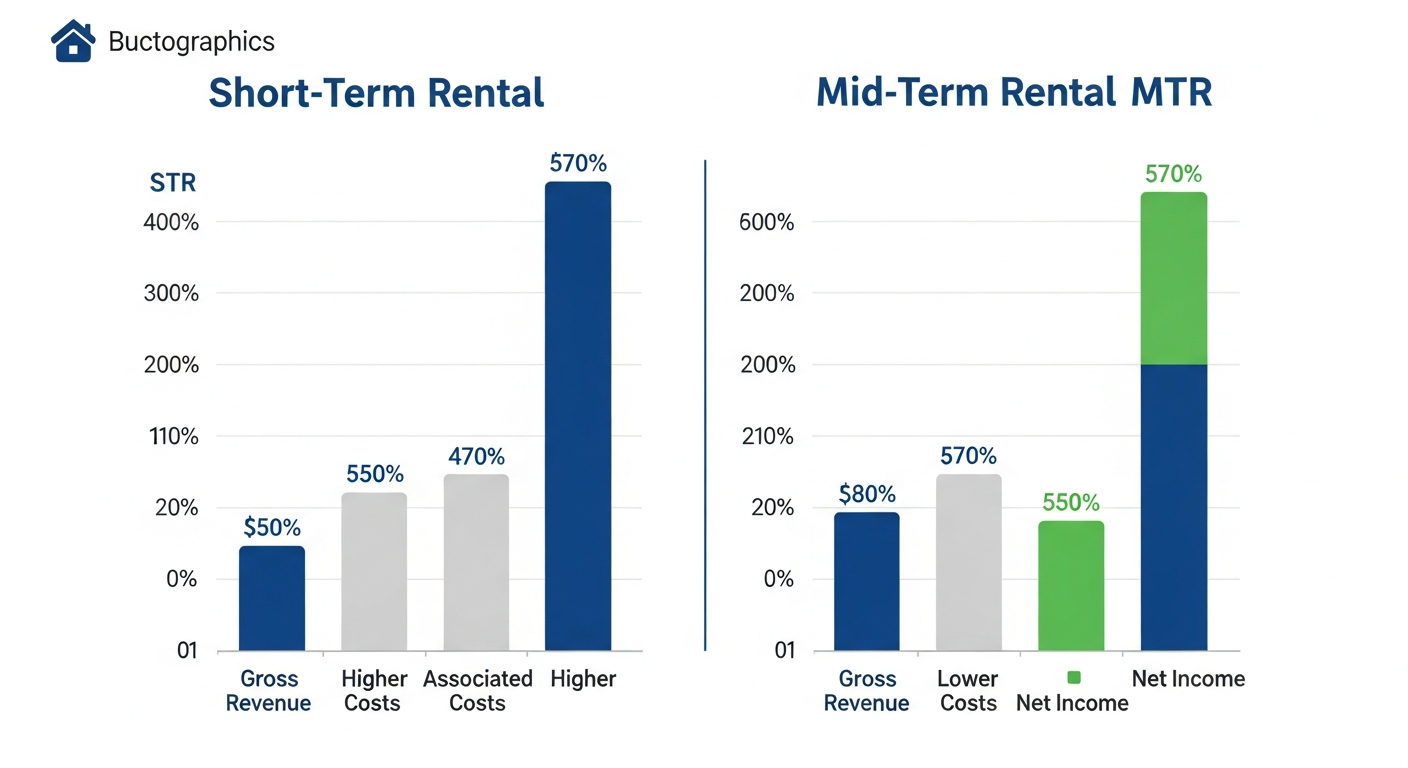
The gross revenue from a mid term rental is lower than a short term rental in the same market. That is the first thing everyone notices. A 2-bedroom apartment that books for $150 per night on Airbnb generates around $38,000 to $55,000 per year at 50-65% occupancy. The same apartment listed as a mid term rental at $2,800 per month generates $33,600 per year at 100% occupancy, or roughly $30,200 at 90% occupancy.
But gross revenue is not income. Income is what remains after you subtract operating costs. And this is where the mid term model pulls ahead.
| Metric | Short Term Rental | Mid Term Rental | Long Term Rental |
|---|---|---|---|
| Gross Annual Revenue | $38,000-$55,000 | $33,600-$45,600 | $21,600-$30,000 |
| Occupancy Rate | 50-65% | 80-95% | 95%+ |
| Operating Cost % of Revenue | 40-60% | 20-35% | 10-20% |
| Net Annual Income | $15,000-$28,000 | $22,000-$34,000 | $17,000-$25,000 |
| Turnovers Per Year | 30-60+ | 3-6 | 0-1 |
| Turnover Cost Per Year | $4,350-$8,700 | $600-$1,200 | $0-$200 |
| Management Hours/Month | 20-40 hours | 3-8 hours | 1-3 hours |
A short term rental that grosses $50,000 per year and costs 50% to operate nets $25,000. A mid term rental that grosses $40,000 per year and costs 25% to operate nets $30,000. That is $5,000 more in your pocket with 80% less management time. This is why operators who have run both models increasingly favor mid term, especially in markets where short term occupancy drops below 55%.
Where the Money Comes From: Who Rents Mid Term Properties
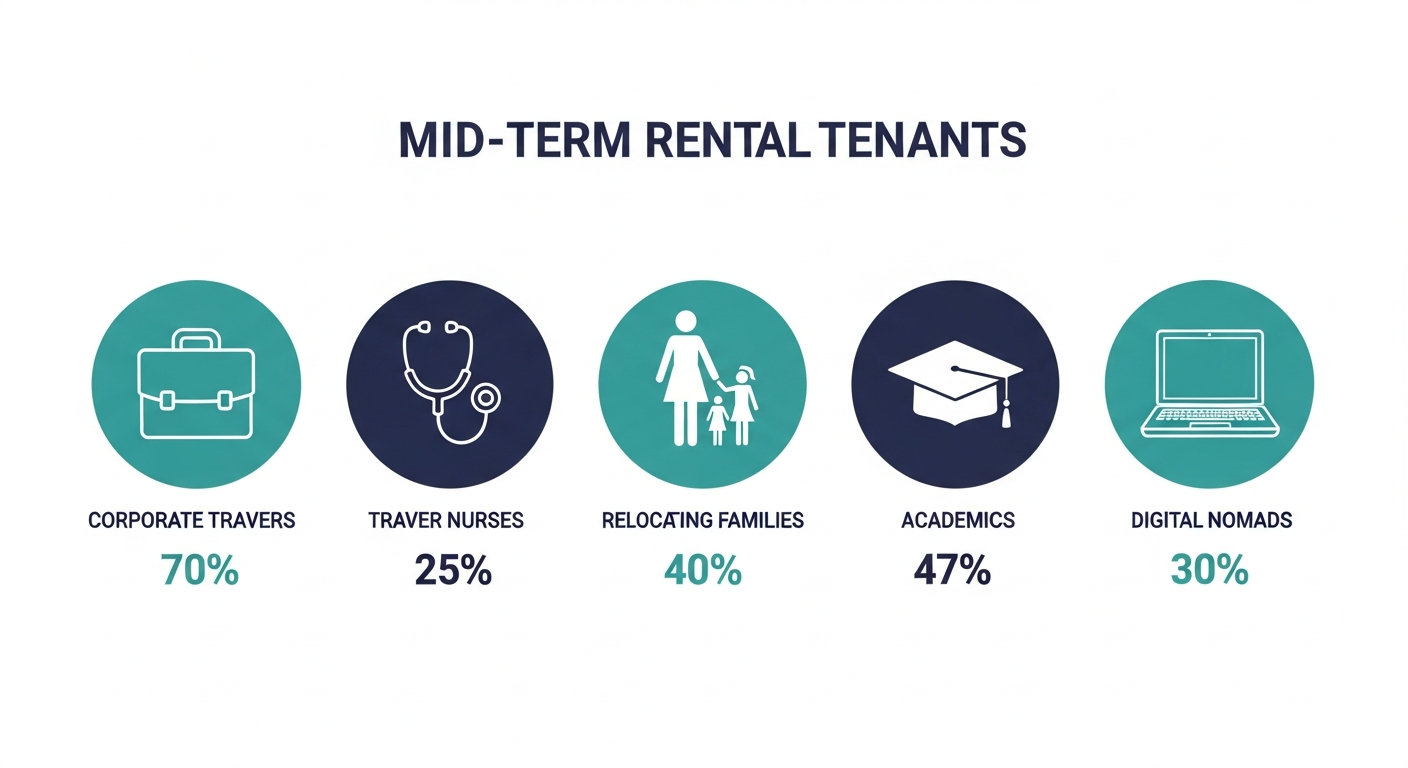
Mid term rental income depends on your tenant base. Different tenant types stay different lengths and pay different rates. Understanding who is looking for 30+ day furnished housing in your market determines your pricing power.
| Tenant Type | % of MTR Demand | Average Stay | Rate Premium Over Long Term Lease |
|---|---|---|---|
| Business travelers and corporate relocations | 30% | 1-3 months | 40-60% above unfurnished rent |
| Travel nurses and healthcare professionals | 25% | 3 months (standard contract) | 35-55% above unfurnished rent |
| Relocating families | 20% | 2-6 months | 25-40% above unfurnished rent |
| Academics and researchers | 10% | 3-9 months | 20-35% above unfurnished rent |
| Digital nomads and remote workers | 5% | 1-3 months | 30-50% above unfurnished rent |
| Insurance displacement and disaster recovery | 10% | 2-18 months | Paid by insurance at market rate |
Travel nurses alone represent a structural, long-term demand source. The Bureau of Labor Statistics projects 197,000 registered nurse job openings annually through 2033, and 33% of the current nursing workforce is approaching retirement age. These professionals need furnished housing for 13-week contracts, and they pay a premium because their housing stipend covers it. Furnished Finder, the largest platform for travel nurse housing, now has over 300,000 property listings and processes over 2 million tenant inquiries per year.
Insurance displacement is the segment most operators overlook. Annual U.S. weather disaster damages exceed $180 billion. When a hurricane, fire, or flood displaces a family, FEMA rental assistance provides initial 2-month awards with extensions up to 18 months. These tenants need furnished housing immediately and the insurance company pays the rent directly. If your property is in a disaster-prone market (Florida, Texas, California, the Carolinas), this tenant segment can fill vacancies fast.
Mid Term Rental Income: City-by-City Examples
Averages are useful but they hide the reality that mid term rental income varies dramatically by city. A 2-bedroom furnished apartment commands very different rates in Nashville than in rural Iowa. Here is what operators are actually earning in strong mid term markets.
Nashville, Tennessee: A furnished 2-bedroom near Vanderbilt University Medical Center rents for $2,800 to $3,500 per month on Furnished Finder. Demand comes from travel nurses at VUMC, music industry professionals on 3-6 month contracts, and corporate relocations. Annual net income after operating costs: $26,000 to $32,000 per unit.
Charlotte, North Carolina: Healthcare expansion at Atrium Health and Novant Health drives consistent travel nurse demand. Furnished 2-bedrooms rent for $2,400 to $3,200 per month. Lower operating costs than Nashville due to cheaper utilities and property management rates. Annual net: $24,000 to $30,000.
Columbus, Ohio: Ohio State University’s Wexner Medical Center creates year-round travel nurse demand. One of the highest mid term rental yield markets in the Midwest. Furnished 2-bedrooms at $1,800 to $2,500 per month with low vacancy. Annual net: $20,000 to $26,000.
Tampa, Florida: Military relocations from MacDill Air Force Base, hospital demand from Tampa General and Moffitt Cancer Center, plus insurance displacement during hurricane season. Furnished 2-bedrooms at $2,400 to $3,200 per month. Annual net: $22,000 to $30,000, with seasonal spikes from disaster displacement.
Detroit, Michigan: The $3 billion expansion of Henry Ford Health campus has made Detroit one of the fastest-growing travel nurse markets. Furnished 1-bedrooms at $2,350 to $3,200 per month. Lower property acquisition costs mean higher cash-on-cash returns. Annual net: $22,000 to $28,000.
These numbers assume standard mid term rental operating costs: furnished unit, utilities included, wifi, basic cleaning between tenants, platform listing fees, and property management if you are not self-managing.
Mid Term vs Short Term Rentals: When to Switch
Not every property should be a mid term rental. And not every market supports it. The decision comes down to three numbers: your current short term occupancy rate, your operating cost percentage, and the mid term rental rate in your market.
Switch to mid term if:
- Your STR occupancy consistently drops below 55%. At that point, the nightly revenue advantage disappears and you are paying for empty nights plus high operating costs.
- Your STR operating costs exceed 45% of gross revenue. Cleaning fees, turnover supplies, guest communication time, and platform fees eat most of your margin.
- Your city has passed or is considering short term rental regulations. A 30-day minimum stay typically qualifies as a standard furnished rental and avoids most STR licensing, permitting, and tax requirements. When New York City passed Local Law 18, over 90% of Airbnb listings were eliminated. Operators who had already shifted to 30+ day stays were unaffected.
- You want to scale beyond 5-10 properties. Managing 20 short term rentals requires a full-time operation. Managing 20 mid term rentals requires a fraction of the time because you have 3-6 turnovers per property per year instead of 30-60+.
Stay with short term if:
- Your STR occupancy is above 65% consistently. The nightly rate premium at high occupancy still outearns mid term rates.
- You are in a peak tourism market (Gatlinburg, Destin, Scottsdale in winter). Seasonal STR revenue can be 3-4x what a mid term tenant would pay.
- Your property is a unique experience (cabin, beach house, luxury villa). These command nightly premiums that mid term tenants will not pay.
The smartest operators run a hybrid model. They book short term during peak season (summer, holidays, local events) and switch to mid term during shoulder and off seasons. This captures the highest revenue per night when demand is strong and fills the gaps with reliable 30-90 day tenants when nightly bookings slow down.
How to Price Mid Term Rentals for Maximum Income
Mid term rental pricing sits between long term lease rates and short term nightly rates. The standard benchmark is 35-55% above the unfurnished long term rent for your market.
If a 2-bedroom apartment rents for $1,800 per month unfurnished on a 12-month lease, a furnished mid term rental of the same unit should price at $2,430 to $2,790 per month (35-55% premium). The premium accounts for furnishing, utilities included, wifi, flexibility of a shorter lease, and the convenience of a move-in-ready unit.
Pricing factors that increase your rate:
- Proximity to a major hospital or medical center (travel nurse demand)
- Proximity to corporate offices or military bases (relocation demand)
- Pet-friendly units (limited supply, high demand from relocating families)
- Dedicated workspace and fast wifi (remote worker demand)
- Washer/dryer in unit (not shared laundry)
- Parking included (especially in urban markets)
Pricing factors that decrease your rate:
- Shared walls or noise issues (travel nurses work night shifts)
- No dedicated workspace (rules out corporate and remote worker tenants)
- Inconvenient location relative to the primary demand driver
- Outdated furnishings or lack of basic kitchen equipment
The Airbnb monthly discount is an alternative pricing path. On average, Airbnb hosts offer a 46% discount for 28+ day stays compared to their nightly rate. This means if your nightly rate is $150, your monthly rate through Airbnb would be roughly $2,430 per month. You can also list on Furnished Finder ($199 per year, no booking fees), Airbnb, Zillow Rentals, and Facebook Marketplace simultaneously to maximize occupancy.
Mid Term Rental Startup Costs and Furnishing Budget
If you are entering mid term rentals through rental arbitrage (leasing a property and subletting it furnished), your startup costs include first month’s rent, security deposit, furnishing, and initial supplies.
The furnishing budget rule of thumb is approximately $7 per square foot. For a 900 square foot 2-bedroom apartment, that is roughly $6,300 for furniture, bedding, kitchen supplies, bathroom essentials, and decor. You can reduce this to $4,000 to $5,000 by sourcing from Facebook Marketplace, estate sales, and IKEA.
| Startup Cost Category | Estimated Range |
|---|---|
| First month’s rent | $1,200-$2,000 |
| Security deposit | $1,200-$2,000 |
| Furnishing (2BR, ~900 sq ft) | $4,000-$7,000 |
| Kitchen/bathroom supplies | $400-$800 |
| Wifi setup + first month | $100-$200 |
| Professional photography | $150-$300 |
| Platform listing fees (Furnished Finder annual) | $199 |
| Total estimated startup | $7,250-$12,500 |
If you do not have $7,000 to $12,000 in startup capital, the co-listing model lets you manage someone else’s mid term rental property and earn 20-25% of the monthly rent without furnishing costs, lease obligations, or financial risk. This is the zero-capital entry point that works for both short term and mid term rentals.
The Regulatory Advantage: Why Mid Term Rentals Are Safer in 2026
Over 200 U.S. cities now have some form of short term rental regulation. Many of these laws define “short term” as stays under 30 days. A 30-day minimum stay typically classifies your property as a standard furnished rental, which means:
- No STR permit or license required in most cities
- No occupancy tax collection obligation in most jurisdictions
- No platform-specific regulations (the laws target Airbnb-style nightly stays)
- Standard landlord-tenant law applies, which is well-established and predictable
The New York City example is the most extreme case. When Local Law 18 took effect, over 90% of Airbnb listings in the city were eliminated. Inventory dropped from approximately 22,000 to 3,200 listings. But operators who had already positioned their properties for 30+ day stays were completely unaffected. Monthly rentals rose from 33% of demand in 2022 to 70% in 2024.
This trend is accelerating. Cities that have not yet regulated short term rentals are watching New York, Los Angeles, San Francisco, and Nashville. Building your business on the mid term model means you are positioned on the right side of every regulation that is coming.
How to Get Started With Mid Term Rentals
If you already operate short term rentals, transitioning one unit to mid term is a low-risk test. Adjust your Airbnb minimum stay to 30 days, list on Furnished Finder, and see what happens to your inquiries over 30-60 days.
If you are starting from scratch, the path depends on your capital:
Zero capital: Start with co-listing. Find property owners who have vacant furnished units or underperforming Airbnb listings. Offer to manage their property on Furnished Finder, Airbnb (30+ day stays), and Zillow Rentals for 20-25% of monthly rent. You manage the listing, handle tenant communication, coordinate cleaning between tenants, and the owner keeps the rest. No lease to sign. No furniture to buy.
$7,000-$12,000 in capital: Rental arbitrage with a mid term focus. Lease a property in a market with strong travel nurse or corporate relocation demand. Furnish it. List on Furnished Finder and Airbnb. Your projected monthly revenue should be at least 1.5x your total monthly costs (rent + utilities + wifi + insurance). If the numbers work, scale to a second unit within 90 days.
$50,000+ in capital: Purchase a property in a high-demand mid term market. The advantage of ownership is that you keep all the revenue and build equity. A 3-bedroom mid term rental in a mid-size market with a $50,000 down payment can produce a 22.8% annualized cash-on-cash return, compared to 8-10% for a comparable long term rental.
Frequently Asked Questions About Mid Term Rental Income
How much can you make with a mid term rental?
A furnished 2-bedroom apartment in a strong market nets $22,000 to $34,000 per year after operating costs. This is often more than the same unit earns as a short term rental once you subtract the higher operating expenses. The exact number depends on your market, property type, and tenant base.
Are mid term rentals more profitable than Airbnb?
On net income (after all operating costs), mid term rentals often outperform short term rentals, especially in markets where STR occupancy drops below 55%. Gross revenue is lower but operating costs are 50% less, turnovers are 90% fewer, and management time drops by 80%. The profitability depends on your specific market and occupancy.
What is the best platform for mid term rentals?
Furnished Finder is the largest platform dedicated to mid term rentals, with over 300,000 listings and 2 million annual tenant inquiries. List your property there and on Airbnb (with a 30-day minimum stay), Zillow Rentals, and Facebook Marketplace to maximize visibility.
Do mid term rentals need a special license?
In most U.S. cities, no. A 30-day minimum stay typically qualifies as a standard furnished rental under existing landlord-tenant law, not a short term rental. Check your local regulations, but mid term stays generally avoid the permitting, licensing, and occupancy tax requirements that apply to nightly STR bookings.
How do I find mid term rental tenants?
List on Furnished Finder (travel nurses and healthcare professionals), Airbnb with 28+ day minimum stay, Zillow Rentals, HousingAnywhere (corporate and international tenants), and local Facebook groups for travel nurses and relocating professionals. The strongest demand comes from healthcare facilities, corporate offices, and military bases near your property.
Can I do mid term rental arbitrage with no money?
Yes, through co-listing. You manage someone else’s furnished property and earn 20-25% of the monthly rent. No lease, no furnishing costs, no financial risk. Co-listing vs rental arbitrage is the same decision in the mid term space as it is in short term: zero capital with lower margins, or invested capital with higher margins.
What is the average occupancy rate for mid term rentals?
80-95% for well-located properties in markets with strong demand drivers (hospitals, corporate offices, military bases, universities). Compare this to 50-65% for short term rentals in the same markets. Higher occupancy means more predictable income and less marketing effort per vacancy.
How much does it cost to furnish a mid term rental?
Budget approximately $7 per square foot. A 900 square foot 2-bedroom apartment costs $4,000 to $7,000 to furnish depending on whether you source new or secondhand. Focus on durable furniture, comfortable bedding, a fully equipped kitchen, fast wifi, and a dedicated workspace. Travel nurses and corporate tenants expect a move-in-ready unit with everything they need for a 3-month stay.
source https://learn.10xbnb.com/mid-term-rental-income/


No comments:
Post a Comment