Airbnb arbitrage for beginners means renting a property on a normal long-term lease, getting written permission from the landlord to host guests, then listing that same unit on Airbnb at nightly rates. You keep the spread between the nightly income and your fixed monthly rent. You never buy the property. A beginner can start one unit with roughly $3,000 to $12,000, no mortgage, and no down payment. This guide explains the rent-to-rent business model in plain English, shows the money math, walks you through a seven-step first deal, and names the beginner mistakes that sink most rental arbitrage attempts.
Airbnb arbitrage, also called rental arbitrage, is the lowest-capital way into short-term rentals. It is not passive income and it carries real risk, mainly the rent you owe whether or not the unit is booked. Treated as a business and run with systems, it is a model thousands of operators use to build a short-term rental business without owning real estate. The rest of this guide is written for a true beginner: no experience with short-term rentals, limited capital, and a goal of getting one unit profitable before thinking about more.
What is Airbnb arbitrage? The rent-to-rent business model explained
Airbnb rental arbitrage is a short-term rental business model where you lease a property long-term and re-list it for short stays. The word arbitrage just means profiting from a price gap. Here the gap is between two markets for the same apartment: the long-term rental market, where a landlord rents it to you for a fixed monthly rent, and the short-term rental market, where travelers pay a nightly rate.
Walk through it. You sign a standard twelve-month lease on a furnished or unfurnished one-bedroom. Your landlord gives you written permission to operate it as a short-term rental. You furnish the unit, photograph it, and list it on Airbnb and VRBO. Guests book it by the night. As long as your nightly income across the month beats your rent plus operating expenses, you keep the difference as profit.
The defining feature is that you do not own anything. With property ownership you need a down payment, a mortgage, closing costs, and good credit. Rental arbitrage skips all of that. Your entry cost is a security deposit, first month’s rent, and furniture. That single difference is why the model attracts beginners with limited capital. If you want the plain-English version first, our explainer on what Airbnb arbitrage actually is covers the basics before you go deeper here.
Three roles make the model work. The landlord or property owner supplies the unit and collects a steady rent. You, the rental arbitrage host, sign the lease, run the listing, and carry the risk. The guests book short stays and pay the nightly rate. Your job is to keep that unit booked enough to cover monthly rent and still produce a profit.
How does the Airbnb rental arbitrage business work?
The Airbnb rental arbitrage business runs on one number: the spread between gross booking revenue and total monthly costs. Everything else is operations in service of that spread. Here is the money flow for a single arbitrage property, with the arithmetic shown so you can copy the structure for any market.
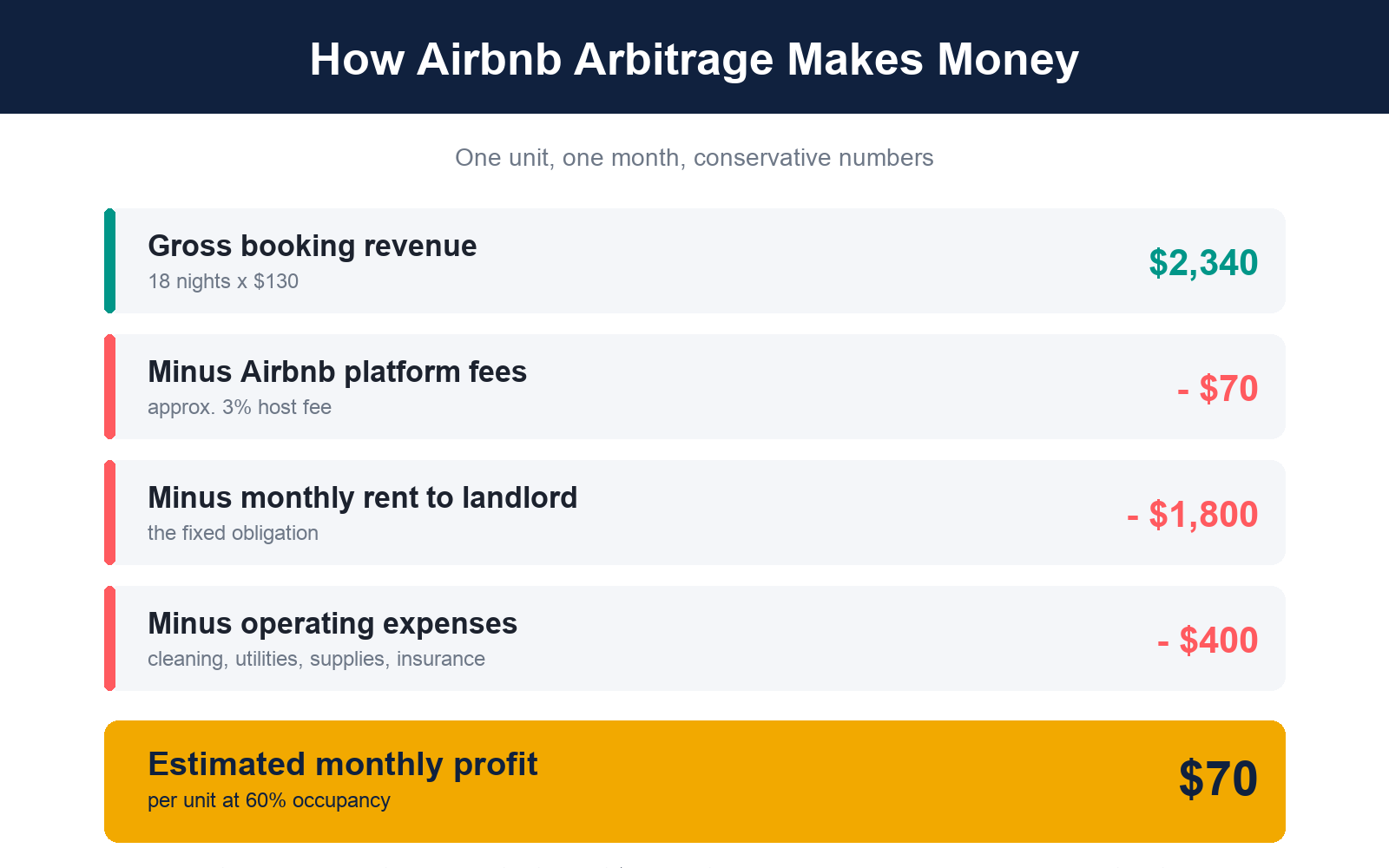
Take a one-bedroom apartment in a mid-size city. The landlord rents it to you for $1,800 per month. You list it on Airbnb at an average nightly rate of $130. AirDNA projected US short-term rental occupancy to recover to roughly 54.9% by the end of 2025, so a beginner should plan conservatively, not optimistically. Use 60% occupancy as a working number, which is about 18 booked nights in a 30-day month.
- Gross booking revenue: 18 nights x $130 = $2,340
- Platform fees (Airbnb host fee, roughly 3%): about $70
- Net booking income: $2,340 – $70 = $2,270
- Monthly rent to the landlord: $1,800
- Operating expenses (cleaning, utilities, internet, supplies, insurance): about $400
- Estimated monthly profit: $2,270 – $1,800 – $400 = $70
At 60% occupancy that example is barely breaking even, and that is the point. The number that decides whether arbitrage works is the gap between long-term rent and short-term rental income. Operators call it the STR premium. If the same apartment booked at 70% occupancy, 21 nights at $130 nets roughly $2,650, and your profit jumps to about $450 from one unit. The math swings hard on occupancy and nightly rate, which is why market research, covered below, is the most important step.
Run these calculations before you sign anything. Our free arbitrage calculator lets you test rent, nightly rate, and occupancy combinations so you can see the profit margin before you commit to a lease.
Is Airbnb rental arbitrage legal?
Airbnb rental arbitrage is legal when three layers all line up. Skip any one of them and you are exposed to eviction, fines, or a shut-down listing. This is the part beginners most often get wrong, so treat it as non-negotiable.
Layer one: Airbnb’s terms. Airbnb allows you to host a property you do not own as long as you have explicit permission from the owner. Airbnb’s own guidance for prospective hosts covers the regulatory homework you are expected to do before listing, in its help article on the legal and regulatory issues hosts should consider. Permission from the property owner is the foundation that legitimate arbitrage stands on.
Layer two: local laws. Short-term rental regulations have tightened across most US cities. Many now require a permit, cap the number of nights you can rent per year, or restrict short-term rentals to a host’s primary residence, which would rule out an arbitrage unit entirely. Check the rules for the exact city, and often the exact zoning district, before you commit. A short-term rental that is illegal in that jurisdiction is dead on arrival.
Layer three: building rules. Even when the city allows it, an HOA, condo board, or co-op can ban short-term rentals in the building. So can the lease itself. Airbnb publishes guidance on how to talk to your building manager about hosting, which is worth reading before you negotiate. If the building prohibits short stays, no lease wording saves you.
The thread tying all three layers together is landlord approval. Subletting a unit for short stays without the owner’s written consent is the fastest route to eviction and a damages claim. Verbal approval is worthless. You need it written into the lease or a signed addendum. Background on how the wider short-term rental sector is regulated is useful context before you pick a market.
How much does it cost to start Airbnb arbitrage?
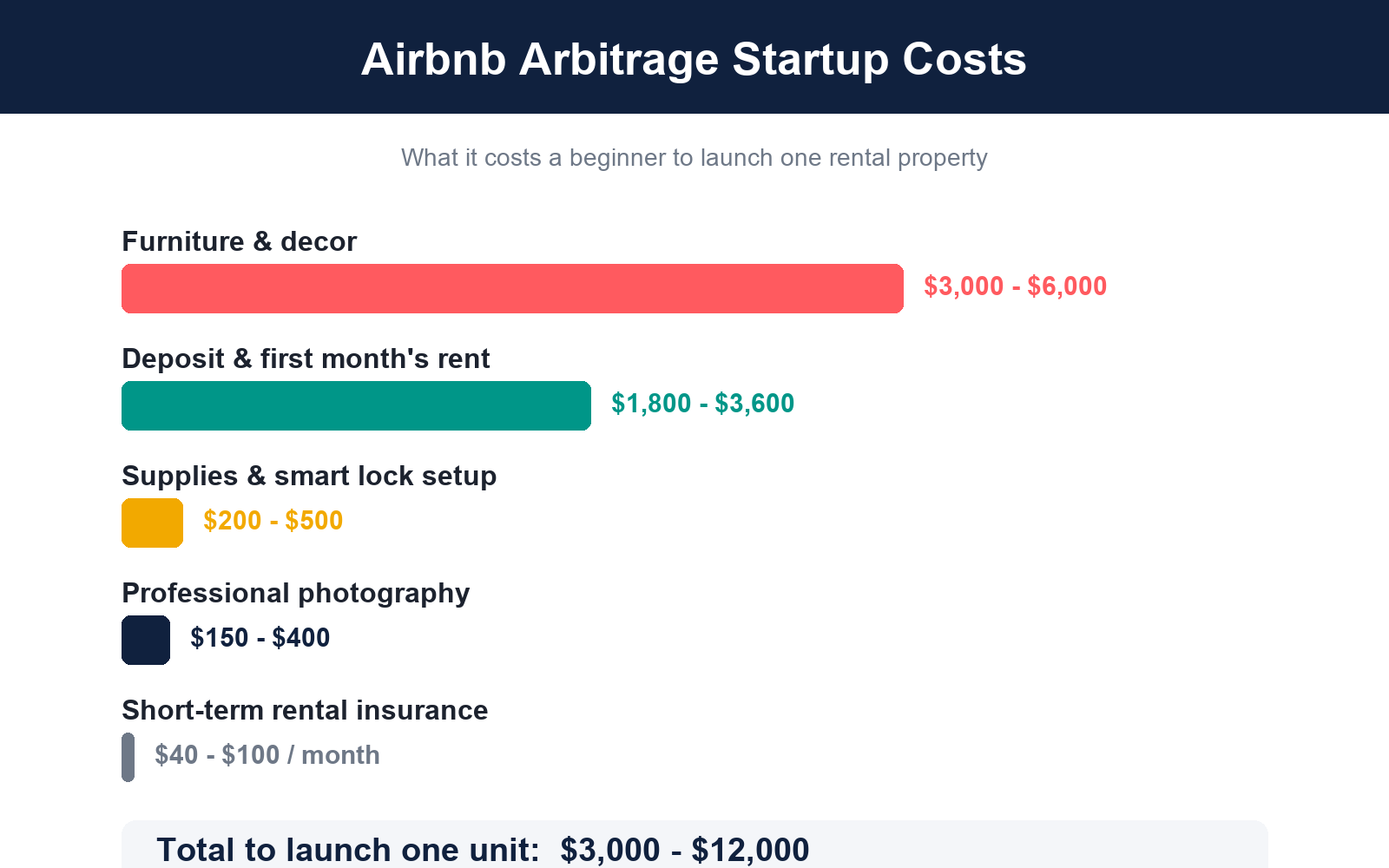
A beginner should budget $3,000 to $12,000 to launch one arbitrage property. The range is wide because it depends on the rent level, the size of the unit, and how nicely you furnish it. Here is where the money goes.
- Security deposit and first month’s rent: often one to two months of rent up front. On an $1,800 unit, expect $1,800 to $3,600 before you get keys.
- Furniture and decor: the largest single category, usually 60% to 80% of startup costs. A basic but solid one-bedroom furnish runs $3,000 to $6,000 covering beds, sofa, table, kitchenware, linens, and decor.
- Photography: $150 to $400 for a professional shoot. This is not optional. Photos drive your booking rate.
- Short-term rental insurance: $40 to $100 per month for a dedicated policy. Standard renters insurance does not cover commercial short-term use.
- Supplies and setup: $200 to $500 for the first stock of toiletries, paper goods, a smart lock, and Wi-Fi setup.
Add an operating reserve on top. Keep two to three months of rent in cash so a slow month or a surprise repair does not break the business. For a deeper line-by-line breakdown, see our guide to rental arbitrage startup costs. If your budget is tight, the page on starting with little money covers ways to lower the entry cost.
How much can a beginner make, and the rent obligation you must respect
A single well-placed arbitrage unit commonly produces a few hundred to a couple thousand dollars in monthly profit, with net margins on a one-bedroom typically landing in the 15% to 30% range. Some units do better, some do worse, and a unit in the wrong market loses money every month. There is no fixed payout, because the result depends entirely on your rent, your nightly rate, and your occupancy.
Now the part that matters more than the upside. The rent obligation is fixed. You signed a lease, so you owe that rent on the first of every month whether the unit was booked 28 nights or zero. Bookings rise and fall with the season, your reviews, and your pricing. Your rent does not move. This single fact is what makes rental arbitrage a real business with real risk, not a passive income shortcut.
Two habits keep the rent obligation from becoming a crisis. First, project occupancy conservatively. Model 55% to 60%, not 75%, so a normal slow stretch still covers rent. Occupancy is not flat across the year either. A unit that books 80% in summer can drop to 40% in a slow winter month, so the average is what matters, not the peak. Second, hold that two to three month cash reserve. A beginner who runs lean with no reserve is one slow month or one Airbnb account issue away from paying rent out of pocket on an empty apartment.
It is also worth being honest about what the first unit is for. The first arbitrage property rarely produces life-changing income on its own. Its real job is to prove you can pick a market, sign a lease, furnish a unit, and run guests profitably. Once that is proven, the income comes from repeating a process you have already de-risked. Beginners who expect one unit to replace a salary tend to quit early. Beginners who treat unit one as paid training tend to still be in the business a year later.
How to start Airbnb arbitrage: a beginner step-by-step
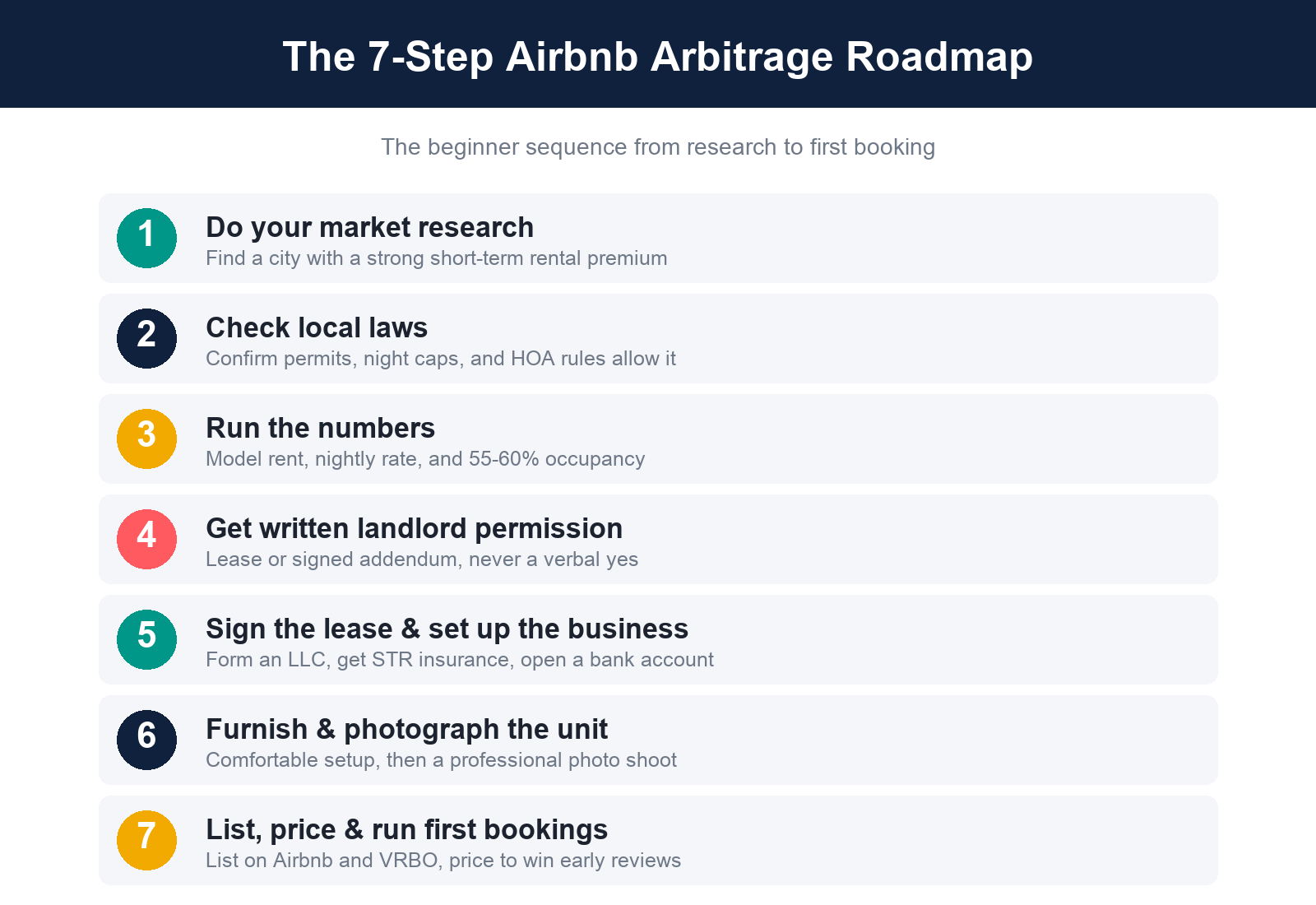
This is the seven-step sequence for landing your first arbitrage deal. Do them in order. Skipping ahead, especially past steps one through four, is how beginners sign bad leases.
Step 1: Do your market research
Market selection is the most important decision you will make, and the most expensive to get wrong. Compare long-term rent against short-term rental income for the same unit type in a city. You want a clear STR premium, meaning short-term rental income runs well above what a long-term tenant would pay. Pull comparable nightly rates and occupancy rates from a data tool, look at year-round demand rather than one peak season, and favor mid-size cities with steady tourism or business travel over saturated, heavily regulated metros.
Good arbitrage markets share four traits. They show a clear gap between long-term rent and short-term rental potential, ideally a two-to-one revenue ratio or better. They have year-round demand from tourism, business travel, medical visitors, or universities rather than one short season. They have manageable short-term rental regulations that allow non-owner-occupied units. And they have reasonable rent levels so your startup costs and monthly rent obligation stay sane. Strong recent performers include markets like Nashville, Tampa, San Antonio, and Scottsdale, but a list is only a starting point. Pull current data for the specific neighborhoods you would actually rent in and verify the numbers yourself, because demand, supply, and short-term rental rules shift fast across the vacation rental industry.
Step 2: Check local laws and short-term rental regulations
Once a market looks promising, confirm the local laws allow it. Search the city’s short-term rental ordinance. Check whether a permit is required, whether nights are capped, and whether non-owner-occupied short-term rentals are allowed at all. Confirm there is no HOA or building-level ban. If the regulations rule out arbitrage, drop the market and move on. This step costs nothing but research time and saves entire businesses.
Step 3: Run the numbers before you sign anything
For each specific apartment you are considering, build the profit math from the example earlier in this guide. Plug in the real rent, a conservative nightly rate, 55% to 60% occupancy, platform fees, and operating expenses. Aim for a rent-to-revenue ratio around 1:2 or better, meaning projected gross revenue is at least double the rent. If the unit only works at optimistic occupancy, it does not work.
Step 4: Find a landlord and get written permission to pay rent and sublease
Approach landlords and property managers directly and be upfront that you intend to run the unit as a short-term rental. Many landlords will say no. Some will say yes, especially if you offer reliability: an LLC on the lease, a corporate-style tenant, professional cleaning between guests, and sometimes slightly above-market rent. Property owners care about consistent rent and a well-kept unit, so frame your pitch around exactly that. A landlord who hears guaranteed monthly rent, professional management, and a tenant who treats the property better than a long-term renter often becomes a partner rather than an obstacle.
Whatever you agree, get short-term rental permission written into the lease or a signed addendum. The addendum should name the short-term rental use, set guest limits, and state who carries liability if a guest causes property damage. Never operate on a verbal yes. Plenty of beginners assume a friendly landlord conversation is enough, then lose the unit when ownership changes or the landlord backs out. Written permission is the one document that protects the whole business.
Step 5: Sign the lease and set up your business
With permission in writing, sign the lease. Form an LLC before or right after. The LLC separates your personal assets from a lawsuit, makes the corporate-tenant pitch to landlords credible, and keeps your taxes clean. Open a business bank account, buy a dedicated short-term rental insurance policy, and register for any permit the city requires.
Step 6: Furnish and photograph the unit
Furnish for durability and guest comfort: a quality bed and mattress, reliable fast Wi-Fi, a stocked kitchen, blackout curtains, and a smart lock for self check-in. Once it is staged, hire a professional photographer. Good photos are the single biggest lever on your booking rate, so this is not where a beginner saves money.
Step 7: List, price, and run your first bookings
Build the listing on Airbnb and VRBO. Listing on multiple short-term rental platforms widens your reach, since some guests only book on one site. Write a clear title and description, list every amenity, and use all your photo slots. Set a competitive opening price slightly below comparable listings to win early bookings and reviews, then raise rates as reviews accumulate. Connect a dynamic pricing tool such as PriceLabs to adjust nightly rates by demand. Then deliver clean stays and fast guest communication so your first guests leave strong reviews, because those first reviews decide how fast future bookings come in.
Expect a ramp. Brand-new short-term rentals book slowly until they have a handful of reviews and a track record, so your first 30 to 60 days will likely run below your target occupancy. Price aggressively early, accept thinner margins on those first bookings, and treat them as the cost of building reviews. Once the listing has social proof, you raise rates toward the market and the unit settles into its real numbers.
How Airbnb arbitrage compares to other ways into short-term rentals
Arbitrage is one of three common ways a beginner enters the short-term rental market, and it helps to see where it sits before you commit. Each path has a different capital requirement, a different risk profile, and a different ceiling.
Buying a rental property. Property ownership is the highest-capital route. You need a down payment, you qualify for a mortgage, and you cover closing costs, often $40,000 or more before the first guest books. The upside is that you own an appreciating asset and have full control. The downside for a beginner is obvious: most people do not have that capital, and a mistake is expensive to unwind.
Co-hosting or managing other people’s listings. At the other end, co-hosting means running someone else’s short-term rental for a percentage of revenue, usually 15% to 25%. It needs almost no capital because you do not hold a lease or own the property. It also has the lowest ceiling, since you only earn a slice of each unit, and you depend on owners who can fire you at any time.
Rental arbitrage. Arbitrage sits in the middle. It needs more capital than co-hosting but a fraction of what ownership demands. You control the listing, the pricing, and the guest experience the way an owner does, and you keep the full spread rather than a commission. The trade-off is the fixed rent obligation and the fact that you are not building equity in real estate. For a beginner with some capital but not enough to buy, arbitrage is usually the fastest route to a real short-term rental business with meaningful monthly cash flow.
A common beginner sequence is to start co-hosting to learn operations with zero risk, then move into rental arbitrage once you have cash and confidence, and only later buy property once arbitrage is funding it. None of the three is strictly better. They are stages, and arbitrage is the one that gets most beginners from learning to earning fastest.
Beginner mistakes that kill a rental arbitrage business
Most failed arbitrage attempts fail for the same handful of reasons. The good news for a beginner is that these mistakes are predictable, so knowing them in advance is the cheapest insurance you can buy. Almost none of them are about being bad at hosting guests. They are about the decisions you make before the first guest ever books.
- Listing without written landlord permission. The single fastest way to lose everything. A landlord who finds out can evict you and pursue damages. Get it in writing or do not list.
- Picking the wrong market. A weak STR premium means thin or negative margins no matter how well you run the unit. Rushing market research to start sooner is a false economy.
- Underestimating startup and operating costs. New hosts routinely miss cleaning fees, platform fees, utilities, restocking, and maintenance, and run 20% to 30% short of their real budget.
- Launching with no cash reserve. Without two to three months of rent set aside, one slow stretch forces you to cover rent on an empty unit.
- Modeling optimistic occupancy. Building the deal on 75% occupancy when the market delivers 55% turns a paper profit into a monthly loss.
- Treating it as passive. Slow guest replies, inconsistent cleaning, and weak listings produce bad reviews, and bad reviews cut bookings fast.
Running it day to day: property management basics
Once the unit is live, the business becomes operations. Day-to-day property management for a short-term rental comes down to a few systems a beginner can run alone at first and delegate later.
Guest communication is constant. Inquiries, check-in instructions, and mid-stay questions all need fast replies, and response speed feeds your Airbnb ranking, which feeds your bookings. Most operators automate the routine messages, a booking confirmation, check-in details, a checkout reminder, so they only handle the genuine questions by hand. Cleaning has to be reliable and consistent between every stay, because guests notice and reviews punish a dirty unit fast. Build a relationship with a dependable cleaner or cleaning company early, and pay for a turnover they can hit between a morning checkout and an afternoon check-in.
Pricing should not sit static. Nightly rates that work in July are wrong in November, and a flat price leaves money on the table on high-demand weekends while pricing you out of slow midweek nights. Dynamic pricing tools like PriceLabs adjust your nightly rates automatically by demand, day of week, season, and local events, and typically lift revenue over flat pricing across a year. Maintenance needs a plan too. A broken air conditioner or a failed Wi-Fi router during a stay can trigger a refund, a bad review, or both, so line up a handyman you can call and keep spare essentials on hand. None of these systems are complicated on a single unit, but they are what separate a short-term rental that holds a strong rating from one that slowly bleeds bookings.
None of this is hard on one unit. It becomes the whole job across several units, which is why operators move from doing the work to building repeatable systems. A beginner should expect to handle every task personally on the first property. That is not a flaw, it is the training. Doing the cleaning handoffs, the guest messages, and the pricing yourself teaches you exactly what to delegate and what good performance looks like before you ever hire it out.
Insurance and taxes belong in the day-to-day picture too. Keep your short-term rental policy active and your business bank account separate from personal money so the LLC protection actually holds. Track every operating expense as you go, because cleaning, supplies, platform fees, and utilities are all deductible against your rental income, and a beginner who waits until tax season to sort receipts leaves money on the table. If you are also weighing the broader picture of starting an Airbnb business from scratch, the same operational discipline applies whether you own or lease.
Scaling from one unit to a vacation rental business with multiple properties
One profitable unit proves the model. A vacation rental business is what you get when you repeat it. Most operators run a single unit until it is consistently profitable, usually within 60 to 90 days, then use that cash flow and the lessons learned to add a second and a third. The first unit is your test. The second is where you find out whether you built a job for yourself or an actual business.
What it takes to grow a short term rental business
Scaling a short term rental business rewards systems, not effort. Managing multiple properties by hand does not work past two or three units. Operators who grow build standard processes for cleaning, guest communication, pricing, and landlord outreach, then hire or use software to run them. The skill that actually scales the business is repeatable landlord acquisition: a reliable way to find and sign new units on good terms. A beginner who treats unit one as a controlled experiment, writing down what worked and what cost money, has a playbook to copy. A beginner who improvises every unit rebuilds from scratch each time and stalls at two or three properties.
Cash flow timing also changes as you scale. Each new unit carries its own deposit, furnishing bill, and one to two month ramp before reviews build and bookings stabilize. Funding that ramp from the profit of existing units, rather than savings, is what keeps growth sustainable. Add units faster than your cash flow supports and a single slow season can strain the whole portfolio at once.
This is the point where structured learning pays for itself. You can piece arbitrage together from free articles, and many people do, but a beginner usually loses months and sometimes a bad lease to trial and error. A focused program compresses that. The fastest way to learn the model properly is the 10XBNB Airbnb arbitrage course, which walks through market selection, landlord scripts, lease terms, and the systems that let you run multiple properties without burning out. If you want guidance from operators who do this for a living, arbitrage coaching and structured arbitrage training shorten the learning curve further. To compare your options first, see our breakdown of the best Airbnb arbitrage courses.
Arbitrage is one route into short-term rentals. If you would rather start with generic hosting fundamentals before the arbitrage model, the Airbnb course for beginners covers standard hosting, and the wider rental arbitrage model guide goes deeper on strategy.
Frequently asked questions
Is Airbnb arbitrage legal?
Yes, when three conditions are met: you have written permission from the property owner, local short-term rental laws allow non-owner-occupied rentals, and the building’s HOA or condo rules do not ban short stays. Without all three, you risk eviction, fines, or a removed listing.
How much money do you need to start Airbnb arbitrage?
Plan for $3,000 to $12,000 for one unit. That covers the security deposit and first month’s rent, furniture, photography, short-term rental insurance, and supplies. Furniture is usually the largest cost. Keep an extra two to three months of rent as a reserve.
Do you need to own property to do Airbnb arbitrage?
No. The entire point of arbitrage is that you never own the property. You rent it on a long-term lease with the landlord’s written permission to host, then list it for short stays. There is no mortgage and no down payment.
Do you need an LLC for Airbnb arbitrage?
An LLC is strongly recommended. It separates your personal assets from a business lawsuit, makes you a more credible tenant when pitching landlords, and simplifies your taxes. Many operators form one before signing their first lease.
How do you get a landlord to allow Airbnb arbitrage?
Be direct about your intent, present yourself as a reliable corporate tenant, often via an LLC, and put the short-term rental permission in writing through the lease or a signed addendum. Some operators offer slightly above-market rent or a profit-sharing arrangement to win approval.
How much can a beginner make with Airbnb arbitrage?
A single well-placed unit commonly nets a few hundred to a couple thousand dollars in monthly profit, with margins on a one-bedroom typically in the 15% to 30% range. Results depend entirely on rent, nightly rate, and occupancy. A unit in a weak market can lose money.
Can you start Airbnb arbitrage with no money?
Genuine arbitrage needs capital for the deposit and furniture, so true zero-dollar arbitrage is not realistic. Beginners with very little money sometimes start by co-hosting or managing other people’s listings for a commission to build cash and skills first, then move into a lease later.
Is Airbnb arbitrage still worth it in 2026?
It can be, in the right market and run as a real business. Short-term rental occupancy has stabilized near pre-pandemic levels, but regulations are tighter and margins are thinner than a few years ago. Success in 2026 depends on careful market research, legal compliance, and disciplined operations.
Your next step
You now have the full picture of Airbnb arbitrage for beginners: what the rent-to-rent model is, how the money works, what it costs to start, the seven-step path to a first deal, and the mistakes to avoid. The model is accessible, but the gap between reading about it and signing a profitable lease is where most beginners stall. A structured program closes that gap fastest. Explore the 10XBNB Airbnb arbitrage course to learn the system step by step, or review the full program details to see how coaching and training fit your goals.
source https://learn.10xbnb.com/airbnb-arbitrage-for-beginners/


No comments:
Post a Comment