The short-term rental tax loophole lets a property owner use rental losses to offset W-2 wages in the same year, without being a full-time real estate professional. It works because the IRS passive activity rules treat a rental where the average guest stay is 7 days or less as something other than a “rental activity.” If you also materially participate in running it, those losses count as non-passive and can reduce your active income, including your day-job salary. The large first-year loss usually comes from depreciation, sped up with a cost segregation study and bonus depreciation.
I have managed properties for owners who ran this play with their accountant, and the mechanics are not a secret or a gray-area trick. Every piece of it sits in published IRS guidance. Below is how the rule works, who it actually helps, and the parts most people skip, like recapture when you sell and the records the IRS expects you to keep.
What the short-term rental “loophole” actually is
Start with the default rule. Rental real estate is normally a “passive” activity. Passive losses can only offset passive income, not your W-2 paycheck or your business profit. That is the wall most owners hit: they have a paper loss from depreciation, but the IRS will not let it touch their salary.
There is a well-known escape hatch called real estate professional status, but it is closed to most people with a job. The IRS says you have to spend more than half of all your working time in real property trades or businesses, and more than 750 hours a year in them, per IRS Publication 925. A full-time W-2 employee almost never clears that bar.
The short-term rental rule is a different door, and it does not require real estate professional status at all. That is the whole reason it gets called a loophole. It is not a loophole in the sense of a mistake in the law. It is a specific treatment the IRS wrote for short-stay rentals, and it has been on the books for years.
The 7-days-or-less test: why short stays are not a “rental activity”
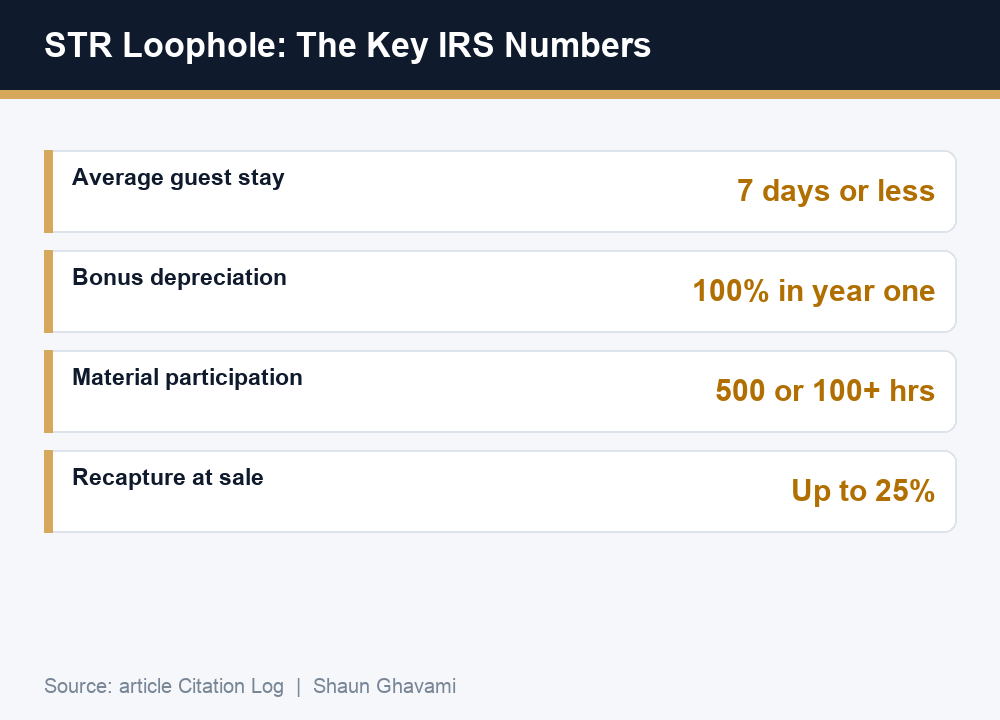
The passive activity regulations (Treasury Regulation 1.469-1T(e)(3)(ii)) list activities that are not counted as “rental activities.” The first one on that list, restated in Publication 925, is simple: “The average period of customer use of the property is 7 days or less.”
Read that carefully. It is the average stay across the year, not every single booking. A property that mostly takes weekend and few-night stays, the typical Airbnb pattern, usually lands under seven days on average. A traditional long-term rental with month-long or year-long tenants does not.
Why does this matter so much? Because once your activity is not a “rental activity,” it is treated like any other trade or business for the passive loss rules. And a trade or business you are involved in can produce non-passive losses. That is the pivot the whole strategy turns on. This is also why the type of hosting you do decides everything, a point I come back to below in who it works for.
Material participation: how the loss becomes non-passive
Clearing the 7-day test is only half of it. To make the loss non-passive and usable against your W-2 income, you also have to materially participate in the activity. The IRS defines material participation with a set of tests in Publication 925 (drawn from Temporary Regulation 1.469-5T). You only need to meet one of them for the year.
The ones short-term rental owners lean on most:
- The 500-hour test: you participated in the activity for more than 500 hours during the year.
- The “did almost all the work” test: your participation was substantially all the participation by anyone in the activity that year.
- The 100-hour test: you participated for more than 100 hours, and at least as much as any other individual, including a cleaner or a co-host.
Time spent booking, guest communication, pricing, restocking, coordinating cleaners and repairs, and bookkeeping generally counts. Hiring a full-service property manager who does everything usually breaks material participation, because then someone else is doing more of the work than you are. If you want the deduction, you have to stay hands-on and log your hours. I keep a dated time record the same way I keep receipts, because the burden is on the taxpayer to prove it.
I walk through how real hosts structure ownership, hours, and cash flow inside the free class. Get the free Airbnb training.
Where the big first-year loss comes from: depreciation
The 7-day test and material participation only open the door. They do not create a loss by themselves. The loss comes from depreciation, and specifically from front-loading it.
Buildings normally depreciate slowly. The IRS depreciates residential rental property over 27.5 years under the schedule in IRS Publication 527 (short-stay properties used mostly on a transient basis can fall into a longer, nonresidential class instead, which is a detail for your CPA). Either way, spreading a building’s cost over decades produces a small yearly deduction, not a big one.
Two rules speed that up dramatically:
Cost segregation
A cost segregation study breaks the property into its parts. Instead of treating the whole building as one 27.5-year (or 39-year) asset, an engineer-based study reclassifies components like appliances, cabinets, flooring, and land improvements into much shorter recovery periods of 5, 7, and 15 years. The IRS Cost Segregation Audit Techniques Guide describes these studies as allocating the total cost of a property across its land, its building, and the appropriate depreciation asset classes. Shorter lives mean far more of the cost can be deducted early. I break the mechanics down further in our guide to cost segregation for short-term rentals.
Bonus depreciation
Bonus depreciation (the “additional first year depreciation deduction” under Internal Revenue Code Section 168(k)) lets you deduct a large share of qualifying shorter-life assets in the very first year instead of spreading them out. This is the highest-stakes number in the whole strategy, because the percentage has changed repeatedly with legislation. As of this writing, the One Big Beautiful Bill restored it: the IRS states the law “provides a permanent 100-percent additional first year depreciation deduction for qualified property acquired… after Jan. 19, 2025,” in its official guidance on the deduction (Notice 2026-11). Confirm the current percentage and the acquisition date rules with your CPA before you rely on them, because this is exactly the kind of figure that moves.
Put together, cost segregation identifies the shorter-life property, and bonus depreciation lets you write off a large chunk of it in year one. Both deductions are reported on IRS Form 4562. That combination is what produces a loss big enough to matter against a salary.
A worked example (illustrative only)
Here is how the pieces fit together with round numbers. Read the label first.
| Step | Assumed figure |
|---|---|
| Purchase price of the short-term rental | $500,000 |
| Portion that is land (not depreciable) | $100,000 |
| Depreciable building basis | $400,000 |
| Share a cost seg study reclassifies to 5, 7, 15-year property | 25% ($100,000) |
| Year-one bonus depreciation on that reclassified property | $100,000 (assumes 100% bonus) |
| Assumed marginal federal rate | 32% (example only) |
| Approximate first-year federal tax reduction | about $32,000 |
The paper loss in this example is roughly the reclassified $100,000 (plus normal depreciation on the rest of the building and ordinary operating costs). If you meet the 7-day test and materially participate, that non-passive loss can offset up to that amount of your active income, including W-2 wages, in the same year. You did not spend $100,000 in cash that year, so a deduction that size against a salary is why owners pursue this. It is a timing benefit, and the next section is the part sellers wish they had read first.
Who it works for, and who it does not
This strategy only works for people who own the property. The entire benefit comes from depreciating an asset you own. No owned building, no depreciation, no loophole. That single fact rules out two of the most common ways people run Airbnbs.
- Rental arbitrage hosts: if you lease an apartment and re-list it, you own nothing to depreciate. You can still deduct your real business costs, but there is no building basis to cost-segregate. Our rental arbitrage guide covers the model and its real tax picture.
- Co-hosts: if you manage other people’s listings for a fee, the depreciation belongs to the owner, not to you. Co-hosting is a great cash-flow business, and I like it, but it does not generate this deduction. See our breakdown of co-hosting.
It works for owners who buy (or already hold) a short-stay property, keep the average guest stay at seven days or less, and stay involved enough to materially participate. If you are still deciding whether to buy at all, our guide on how to start an Airbnb business and the real Airbnb startup costs are the honest starting point, and market choice matters, so look at the most profitable Airbnb cities before you commit capital.
The caveats the sales pitches skip
Depreciation is not free money. It lowers your cost basis, and the IRS takes its share later. Here is what to plan for.
Depreciation recapture at sale
When you sell, the gain tied to depreciation you claimed gets recaptured. For the building portion, the IRS taxes unrecaptured Section 1250 gain “at a maximum 25% rate,” per IRS Topic 409. The shorter-life personal property from your cost seg study (Section 1245 property) is generally recaptured as ordinary income. That is why this is a deferral, not a permanent escape. Some owners defer it further with a 1031 exchange, but that has its own rules to check with your CPA.
Documentation and audit risk
Material participation and cost segregation are both areas the IRS looks at closely. You need contemporaneous time logs, and a cost seg study should be done by qualified professionals, not guessed at. Sloppy records are the fastest way to lose the deduction on audit.
It is not automatic, and Schedule C is a trap
You have to qualify every year. If your average stay creeps above seven days, or you hand the work to a manager and stop participating, the treatment changes. And if you provide hotel-level “substantial services,” the IRS may push your rental onto Schedule C, where profits face self-employment tax. Our comparison of Schedule E vs Schedule C for Airbnb walks through where that line sits. Beyond depreciation, keep clean books on the everyday write-offs too, our list of Airbnb tax deductions covers those.
None of this is a reason to avoid the strategy. It is a reason to run it with a professional. I do not file this on my own, and I would not want you to either. If you do not have someone yet, start with what to look for in an Airbnb tax accountant.
The free training shows how hosts get started, whether you own, arbitrage, or co-host. Get the free Airbnb training.
Frequently asked questions
Yes. It is a treatment written into the IRS passive activity rules, not a trick. A rental with an average guest stay of 7 days or less is not a “rental activity” under Publication 925, so if you materially participate, the losses can be non-passive. It is general education here, not tax advice, so confirm your situation with a CPA.
No, and that is the point. Real estate professional status requires more than half of your working time and over 750 hours a year in real property businesses, which most W-2 earners cannot meet. The short-term rental rule instead relies on the 7-day average stay plus material participation, per IRS Publication 925.
No. The benefit comes from depreciating a building you own. If you lease and re-rent (arbitrage) or manage other people’s listings (co-hosting), you own no property to depreciate, so there is no first-year loss to offset your W-2 income. You can still deduct your ordinary business expenses.
IRS Publication 925 lists activities that are not “rental activities.” The first is when “the average period of customer use of the property is 7 days or less.” It is the average across the year, not every booking, which is why typical short-stay Airbnbs qualify and long-term leases do not.
Largely, yes. Depreciation reduces your cost basis, so at sale the IRS recaptures it. Unrecaptured Section 1250 gain on the building is taxed at a maximum 25% rate per IRS Topic 409, and shorter-life cost seg property (Section 1245) is generally recaptured as ordinary income. Treat the deduction as a deferral, not free money.
No. This is general education, not tax advice. Tax rules change and depend on your situation. Consult a licensed CPA or tax professional before acting on any of it.
source https://learn.10xbnb.com/short-term-rental-tax-loophole/

