Quick Answer: Best Airbnb Investment Platforms in 2026 (Real Returns, Real Markets, Real Data)
The five categories of airbnb investment platforms in 2026 are passive STR funds (TechVestor, $25K minimum, accredited only, 5-year lockup), white-glove acquisition services (Awning, full property purchase support, 10 to 15 percent management fee), co-ownership platforms (Pacaso, fractional luxury second homes), turnkey single-family STR (Roofstock STR, full property + management), and the DIY operator path (zero platform, you own and operate). For high earners who want real control, real returns, and the OBBBA tax advantages, the DIY path beats every platform on capital efficiency. Platforms make sense when you specifically do not want to operate.
I have evaluated every airbnb investment platform a serious real estate investor would consider, looked at the actual revenue and occupancy rates each one delivers in real airbnb markets, watched students try most of them, and built a $5M portfolio of short term rental property without using any of them. The honest comparison below is what I tell people who ask which airbnb investment platforms are worth their capital. The answer depends on whether you want passive exposure to vacation rentals or full control over the operating data, the pricing, and the location.
What “best airbnb investment platforms” actually means in 2026
The phrase “best airbnb investment platforms” gets used loosely. Some people mean a fund that invests in short term rental property and pays distributions. Others mean an airbnb calculator they plug numbers into to evaluate an investment property purchase. A third group means a property management company that lets them buy a vacation rental in a chosen city and hand it off to a property management partner that handles the data and the pricing. All three are real airbnb investment platforms, but they answer different problems for different airbnb investors with different capital, time, and market preferences.
For the high-income W-2 professional, the most useful framing is this: every airbnb investment platform sits somewhere on a spectrum (from data-tool to fully managed real estate fund) from full passivity (you wire capital and never touch the asset) to full control (you operate the airbnb business yourself, including pricing, listing optimization, and revenue analytics). Platforms in the middle of this real estate market spectrum trade some control for some convenience and charge accordingly. The platform you should use depends on which trade-off you accept.
The five categories of airbnb investment platforms
Here is the actual landscape of airbnb investment platforms in 2026. Skip whichever does not apply to your capital, your target city, your investment timeline, or your risk tolerance.
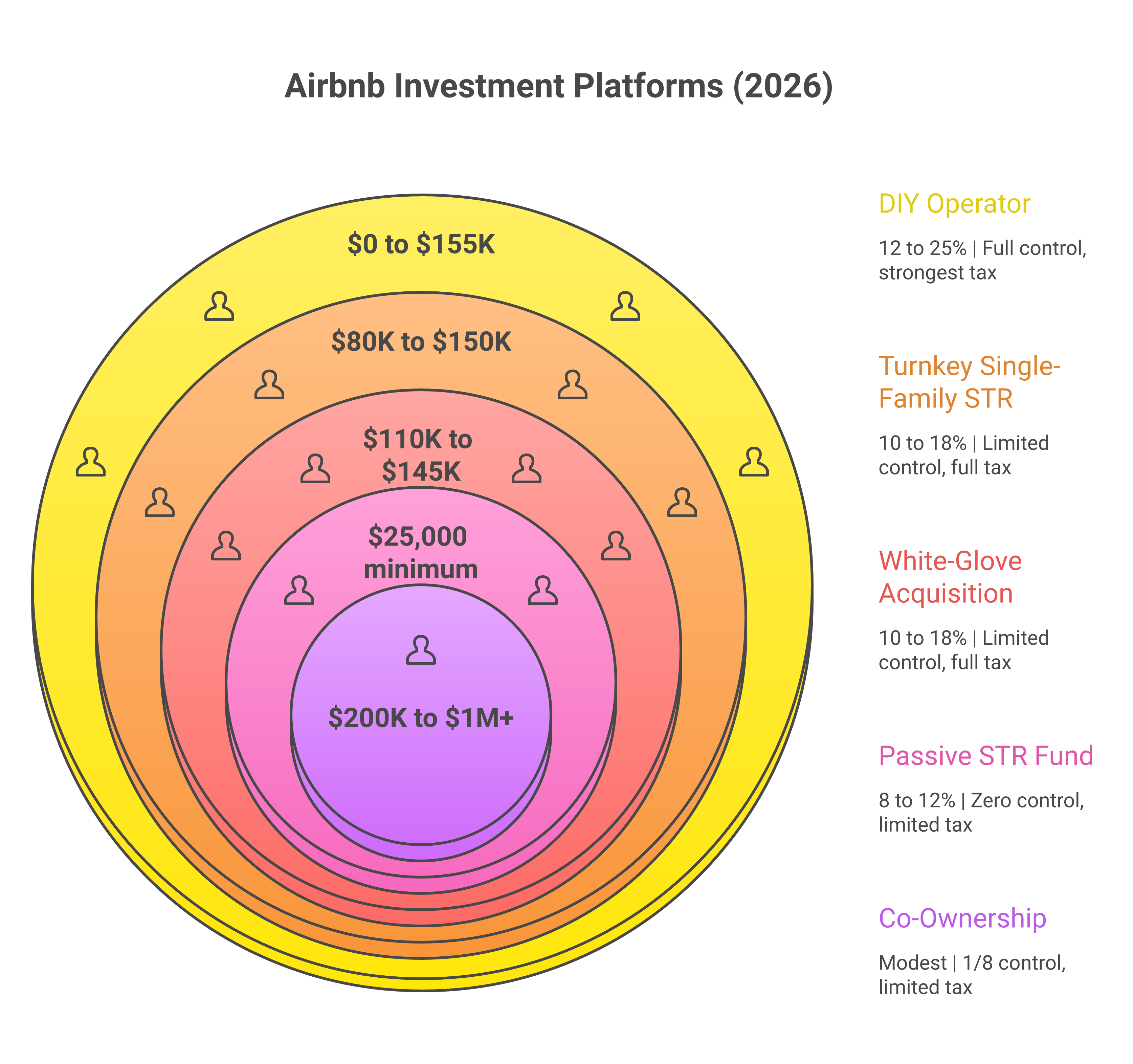
- Passive STR funds: TechVestor is the visible name in the passive vacation rentals fund market segment. You commit $25,000 minimum as an accredited investor. Capital is locked for five years. The fund acquires and operates a portfolio of properties across multiple markets and neighborhoods, using its own market data and revenue projections to pick locations across multiple cities and pays you quarterly distributions. Best for accredited investors who specifically do not want any operating involvement and want to invest passively in vacation rentals.
- White-glove acquisition and management: Awning is the visible name in white-glove acquisition for vacation rentals. They source data on the city, the neighborhood, and the local market trends. Then they analyze and acquire an investment property on your behalf at the right purchase price, then operate it under a management agreement. You own the asset. Best for high earners who want to invest in airbnb investment property but skip the location research, the pricing analysis, and the budget legwork.
- Co-ownership of luxury second homes: Pacaso is the visible name in luxury second-home co-ownership. You buy a fractional share (typically 1/8) of a high-end vacation home through an LLC. Pacaso manages the property and the scheduling. Best for second-home buyers who want a luxury vacation home (and connect with a curated co-owner pool) without writing the full check.
- Turnkey single-family STR: Roofstock STR (the airbnb-focused arm of Roofstock) sells single-family rental properties from real estate markets nationwide with management ready to plug in. Best for investors who want full ownership of a single asset, with city-level revenue and occupancy rate data, without doing the property hunt.
- The DIY operator path: No platform. You research airbnb markets (see our 2026 best Airbnb markets ranking and our profitable Airbnb cities data), pull occupancy rates and average daily rate data from AirDNA or Rabbu, run an airbnb calculator on candidate properties, finance the purchase, furnish it, and operate it yourself. Best for high earners who want the strongest returns, the OBBBA tax angle, full control over guest communication, pricing, and rental rates, and direct connection to the local market. This is the path 10XBNB students take.
TechVestor review: the passive airbnb investment fund
TechVestor is the most visible passive airbnb investment platform in 2026 in the U.S. Real estate market. The fund acquires 4 to 6 bedroom homes in high-yield airbnb markets across multiple cities, using internal market data to pick locations, furnishes and operates them, and distributes quarterly cash flow to limited partners.
TechVestor minimums and structure
The TechVestor minimum investment is $25,000. You must be an accredited investor under SEC rules: $200,000 in individual income for the past two years (or $300,000 jointly), or net worth above $1 million excluding primary residence. The fund is structured as a 506(c) Reg D offering.
Capital is locked up for five years. You cannot pull out early. If the fund underperforms, your only choice is to wait for the liquidation event at the end of the hold period.
TechVestor returns
Independent reviews on BiggerPockets, Physician on FIRE, and NewSilver report cash on cash returns in the 8 to 12 percent range on the underlying real estate with quarterly distributions. The fund targets 4 to 6 bedroom homes generating around $120,000 a year in rental income per property. Reported occupancy rates run higher than the industry average of 60 percent, though the specific 79 percent number cited in 2023 quarterly reports has not been consistently reproduced in subsequent investor disclosures.
Known concerns about TechVestor
Forum threads on BiggerPockets surface specific concerns. Co-founder Sief Khafagi previously ran Scoutpads, Metallic Blue Development, and Superhost Labs, all of which went bankrupt. Some current and former limited partners (the investors who provided the capital) have publicly questioned the fund’s reporting practices. None of this proves the fund is unsuitable as an airbnb investment, but it is information any serious accredited investor should weigh before wiring capital.
Who TechVestor is right for
TechVestor is right for accredited investors who want pure short term rental exposure without any operating involvement, who can lock up capital for five years, and who accept 8 to 12 percent cash flow returns in exchange for zero time investment. It is wrong for anyone who wants meaningful tax advantages (passive activity loss rules limit what depreciation a passive fund investor can deduct) or anyone who wants control over the operating decisions.
Awning review: the white-glove airbnb investment property service
Awning operates differently in the airbnb investment landscape. Rather than pooling capital into a fund, Awning helps individual investors find, analyze, and acquire short term rental property in markets across the U.S. Once you own the airbnb investment property, Awning’s management arm operates it for you under a separate fee.
Awning model and capital requirements
Awning is open to all investors, not just accredited ones, which expands the budget profile of clients and locations they can serve, including investors who want to deploy revenue from rental rates rather than capital from outside. Because you buy individual airbnb investment property directly, the minimum investment is whatever the property costs: typically a 20 to 25 percent down payment plus 2 to 4 percent closing costs plus $15,000 to $40,000 in furnishing for a 3-bedroom property. On a $350,000 property at typical rental rates for a 3-bedroom location, plan for $110,000 to $145,000 in total cash budget to close and launch.
Awning fees and management terms
Awning charges 10 to 15 percent of revenue on the airbnb listings under management for property management on most markets, lower than Vacasa’s 25 to 45 percent (when add-ons are included). The hold period is whatever you choose because you own the asset. You can sell, refinance, or transfer the airbnb business whenever you decide.
Known concerns about Awning
Awning was founded in 2020, so it is a relatively new company by industry standards. Interior design fees, furnishing services, and insurance riders are billed separately from the management fee. Some investors find the upfront acquisition fees push the total cost above what they expected. The model is solid but the all-in expense ratio is closer to 18 to 22 percent of revenue once everything is included.
Who Awning is right for
Awning is right for investors with capital but no time to search for properties. If you have $150,000 to deploy and zero hours to spend on market research, Awning’s acquisition team will find a candidate, run the analysis, and hand you a turnkey airbnb investment. Compared to TechVestor, you keep ownership and the depreciation deductions. Compared to DIY, you pay an acquisition premium and management fees that compress your cash flow.
Pacaso review: co-ownership of luxury second homes
Pacaso is in a different category from the others on this list. The platform sells fractional ownership (typically 1/8 shares) of luxury second homes through an LLC structure. You buy a share, you get scheduling rights for a portion of the year, and Pacaso manages the property year-round.
Pacaso model and what you actually buy
A 1/8 Pacaso share entitles you to roughly 45 to 47 days a year (6 stays) at the second home, scheduled through a SmartStay platform that prevents conflicts with the other owners. The properties are typically luxury homes in destinations like Lake Tahoe, Aspen, the Hamptons, and Cabo. Share prices range from approximately $299,000 to over $1 million depending on the property (a 1/8 share in a Palm Springs 3-bedroom recently listed at $299K, while a Breckenridge 4-bedroom listed at $755K).
Pacaso as airbnb investment
This is where it gets detailed. Pacaso is positioned as a vacation home solution, not a pure airbnb investment platform. The revenue model favors personal use over rental income. Owners can rent out unused weeks via airbnb, but rental income on a fractional Pacaso share is modest compared to other vacation rentals because most of the prime weeks are reserved by the co-owners (limiting rental rates the asset can charge). Pacaso is investment-adjacent: you get appreciation exposure on a luxury second home, but cash flow is limited.
Who Pacaso is right for
Pacaso is right for buyers who want a luxury vacation home without writing the full check, who plan to use the property for personal vacations rather than maximum rental income, and who accept that fractional ownership trades cash flow for lifestyle. It is wrong for pure airbnb investment because the underlying mechanics optimize for personal use, not for revenue.
Roofstock STR: turnkey single-family rental investment property
Roofstock built its primary business around single-family long term rentals in markets nationwide, and the company expanded into short term rental in recent years. Roofstock STR markets a curated set of single-family rental property listings (with pricing data, neighborhood analysis, and occupancy rates) that come with management partners ready to operate the airbnb business from day one.
Roofstock STR model and pricing
You buy the property at retail with full transparency on the data Roofstock used to vet the location. Roofstock’s value is in the curation: properties on the platform have been pre-vetted for STR-friendly regulations, market data, and management readiness. You finance and close like any conventional investment property purchase. Down payments and financing terms match what you would see on any other airbnb rental property in the same market.
Where Roofstock STR fits in the airbnb investment platforms landscape
Roofstock STR sits between Awning and DIY. Awning runs a more hands-on acquisition process. Roofstock is closer to a marketplace where you self-select from a vetted list. Both options keep ownership and OBBBA tax benefits in your name, unlike a passive fund.
The DIY operator path: no platform, full control, strongest tax advantages
This is the path most 10XBNB students take. You skip the airbnb investment platforms entirely. You research airbnb markets using an airbnb calculator and city-level data tools like AirDNA, Rabbu, or Mashvisor (compared in our best Airbnb analytics tools 2026 review). You finance and buy a single investment property in a city you understand and can connect with locally, using your own pricing and revenue data to validate the investment. You furnish it, list it on airbnb and Vrbo, and operate it yourself or with a small team of cleaners and a handyman.
Why DIY beats the platforms on returns
The math is straightforward. Every platform takes a slice of the revenue. TechVestor takes its management fee plus carry on the revenue upside. Awning takes 10 to 15 percent of revenue plus acquisition fees plus furnishing markups. Pacaso takes a quarterly management fee on top of an upfront premium. Roofstock takes a transaction fee plus its management partner takes 20 to 30 percent of revenue.
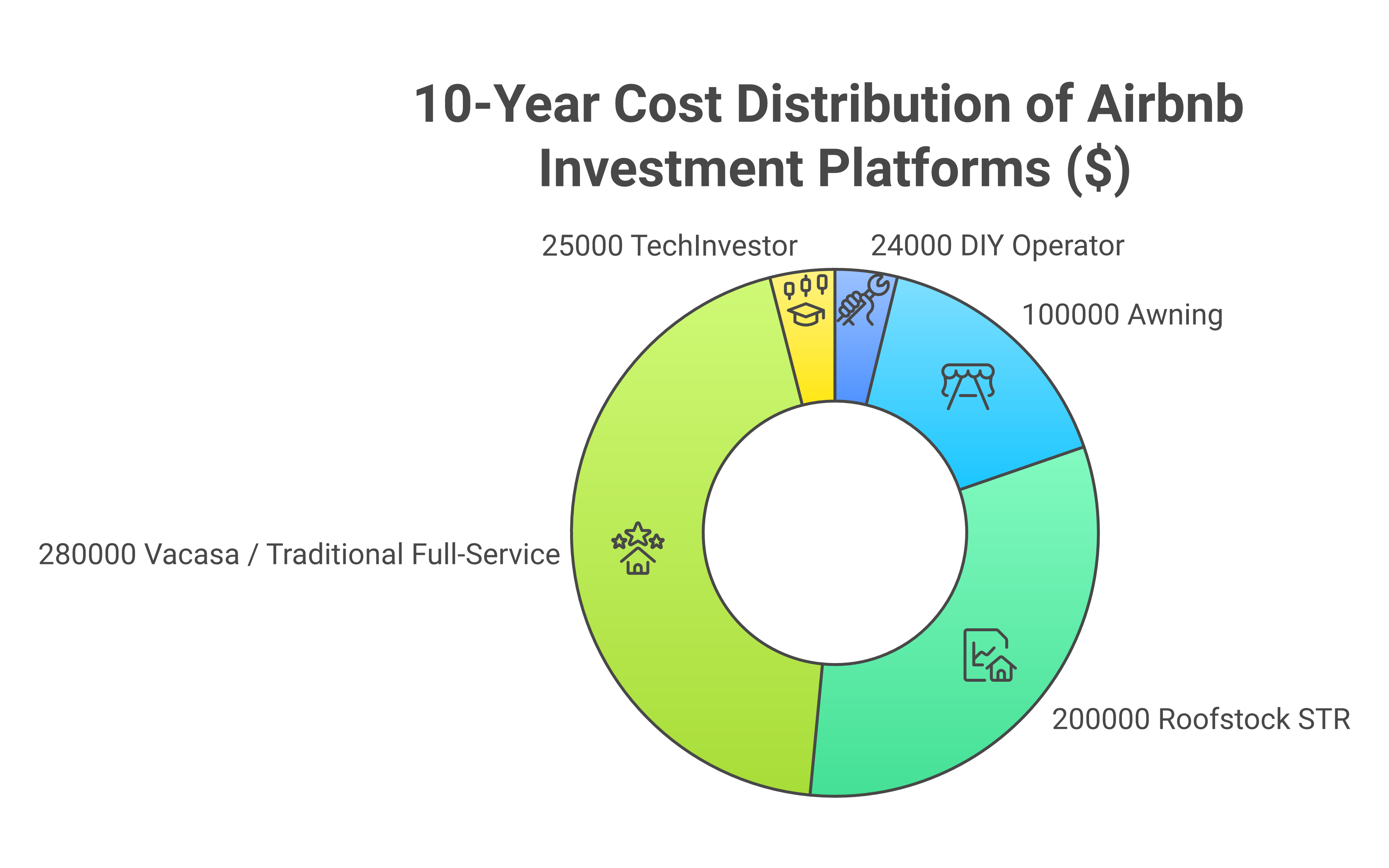
The DIY operator keeps all revenue. On an $80,000 a year airbnb business (typical revenue from a 3-bedroom property in a B-tier market), that is the difference between netting $50,000 to $55,000 (DIY) and netting $40,000 to $45,000 (with most platforms in this list).
Why DIY wins on the tax angle
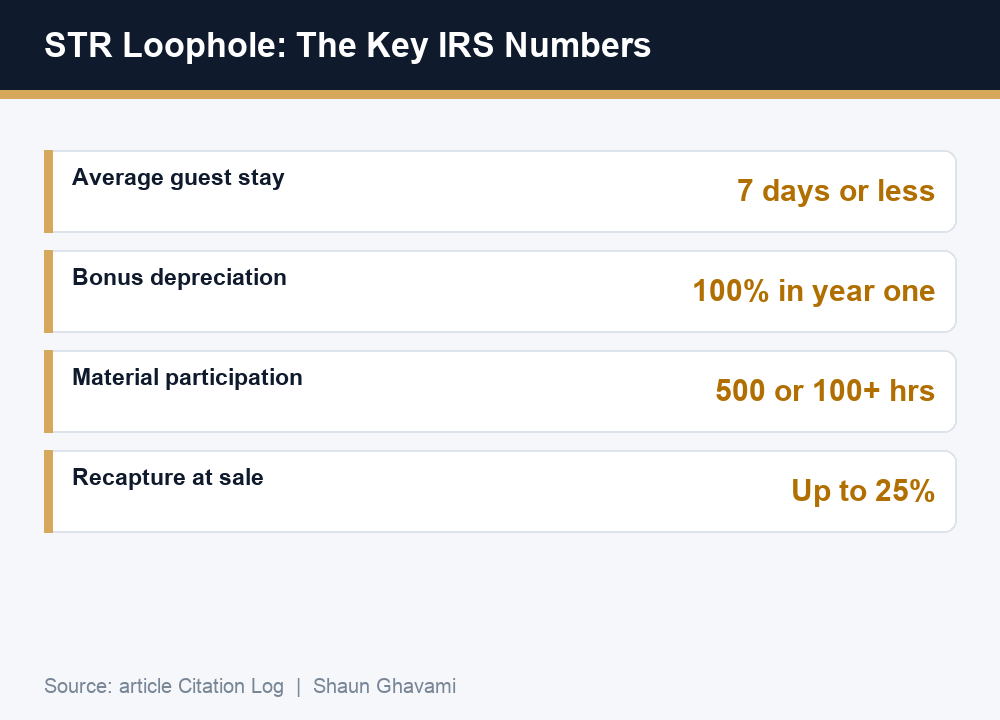
The OBBBA short term rental loophole only fully works for active operators with material participation in the airbnb business. Passive fund investors get diluted depreciation. Platform-managed properties can still use OBBBA but require careful documentation that you materially participate (the 100-hour test or 500-hour test) which is harder when a manager handles operations.
For a high-income W-2 professional in the 40 percent combined federal-and-state bracket, the OBBBA bonus depreciation strategy on a $400,000 property generates $30,000 to $60,000 in year-one tax savings under DIY operation. That savings drops sharply or disappears when a fund or a property manager controls operations.
How to start the DIY path
Read our complete guide on how to invest in short-term rentals for the seven-step playbook from market selection to placing into service. Pair it with our airbnb rental arbitrage guide if you want to start without a property purchase, and our how to become an airbnb co-host guide for the zero-capital on-ramp.
Side-by-side comparison of the airbnb investment platforms
The categories side by side, scored on what matters most:
- TechVestor: Capital $25K min. Lockup 5 yr. Cash flow 8 to 12 percent. Tax advantages limited (passive). Control zero. Best if you want pure passive exposure with accredited capital.
- Awning: Capital $110K to $145K (full property). Lockup flexible. Cash flow 10 to 18 percent post-management. Tax advantages full ownership benefits (OBBBA available with documentation). Control limited by management agreement.
- Pacaso: Capital $299K to $1M+ per share. Lockup typically 12 month minimum hold; longer for tax advantages. Cash flow modest (co-ownership limits rental income). Tax advantages limited (mostly personal-use). Control 1/8 of scheduling.
- Roofstock STR: Capital $80K to $150K (full property). Lockup flexible. Cash flow 10 to 18 percent post-management. Tax advantages full (with material participation documentation). Control limited by management partner.
- DIY operator: Capital $0 (co-listing) or $5K (rental arbitrage) or $115K to $155K (DIY ownership). Lockup zero (you decide). Cash flow 12 to 25 percent. Tax advantages strongest (OBBBA + STR loophole). Control full.
For high-income real estate investors choosing among airbnb investment platforms, the key questions are: how does each platform handle market selection (city-level data, neighborhood-level pricing, occupancy rates), what is the budget you actually need to deploy, and what is the platform’s hold-period structure? Most platforms publish market data to support their pitch, but the data quality varies and the underlying real estate market can shift quickly. Always verify a platform’s claims against independent sources like AirDNA’s vacation rentals dataset or Rabbu’s revenue projections.
Which airbnb investment platform is right for you?
Three honest filters cut this decision down quickly. First: are you accredited? If not, TechVestor and similar passive airbnb investment property funds are off the table. Second: how much time can you put into the airbnb business per week? If the answer is zero, you are looking at TechVestor or a fully-managed Roofstock listing. Third: do you care about the tax advantages? If yes, you must own the asset and you must materially participate, which rules out the passive fund.
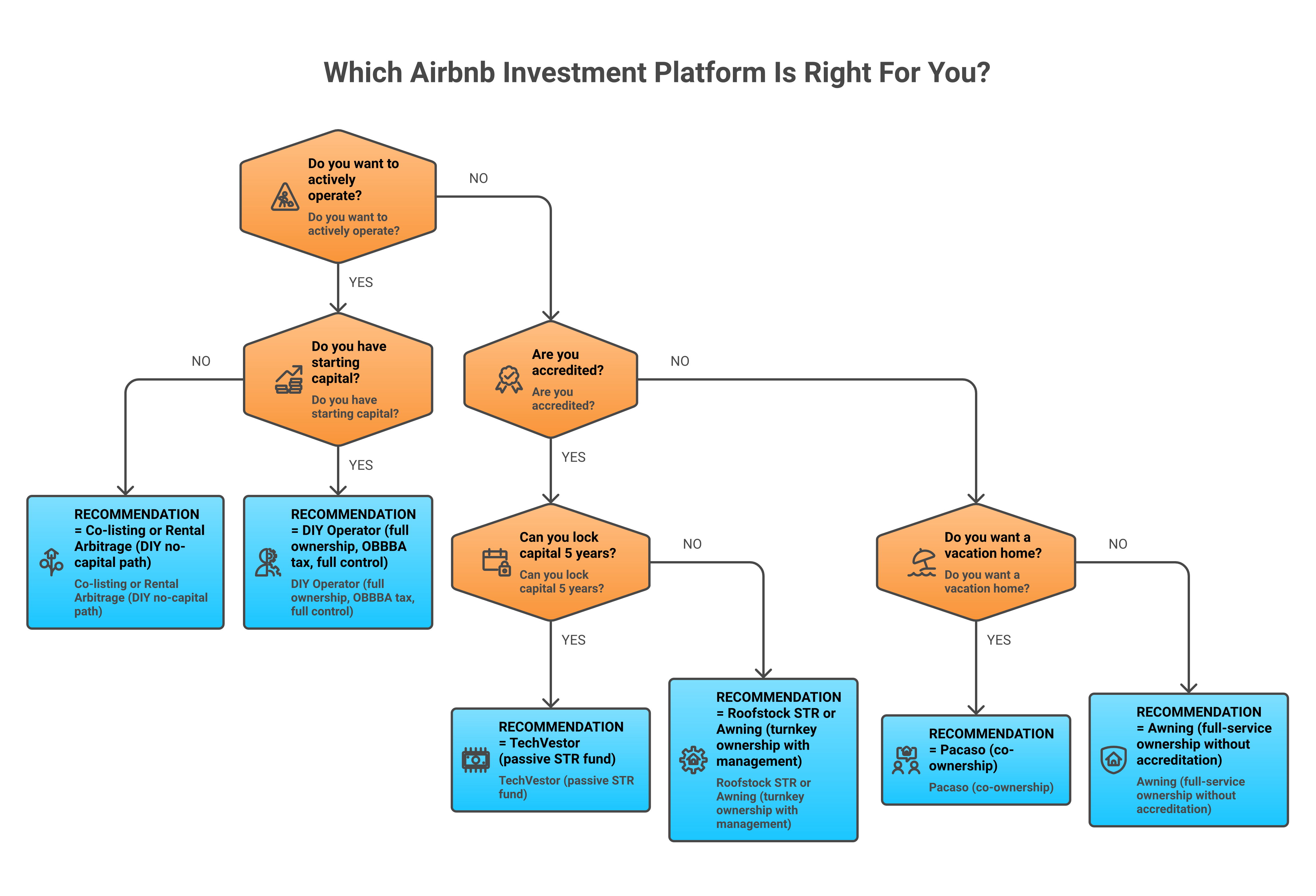
For the typical 10XBNB student profile (high-income W-2 professional, $100,000 to $300,000 income, willing to put in 5 to 15 hours a week), the DIY operator path beats every platform on returns, control, and tax outcome. For accredited investors who specifically do not want to operate, TechVestor is the cleanest passive vehicle. For investors with capital and zero time who still want ownership, Awning and Roofstock STR are reasonable middle-ground options.
Final thoughts on choosing among airbnb investment platforms
The honest answer to “which are the best airbnb investment platforms” is: it depends on what you are optimizing for. Optimize for passivity and you accept lower returns and weaker tax advantages. Optimize for returns and you accept the operating workload (the best Airbnb courses in 2026 review covers training options for the DIY path). The platforms that exist in 2026 trade these two goods at different prices. None of them is universally best.
If your goal is wealth-building rather than just exposure, the math almost always points to the DIY operator path. If your goal is genuine passivity and you have capital that can sit for five years, a passive fund like TechVestor is a reasonable allocation. The airbnb investment platforms in between solve real problems for specific investors but rarely produce best-in-class outcomes on either dimension.
Frequently Asked Questions about airbnb investment platforms
What is the minimum investment for TechVestor?
The TechVestor minimum is $25,000 and you must be an accredited investor. Accredited status requires either $200,000 in individual income over the past two years ($300,000 jointly) or net worth above $1 million excluding primary residence. The fund is a 506(c) Reg D offering with a 5-year capital lockup.
Are airbnb investment platforms passive income?
Only the fund-style platforms like TechVestor are truly passive. Awning, Pacaso, and Roofstock STR all involve ownership of an underlying asset, which means tax decisions, financing decisions, and management oversight responsibilities even if a manager handles day-to-day operations. The DIY operator path is explicitly active in the first year and only becomes lighter once systems are mature.
Which airbnb investment platform has the best returns?
Returns vary by location and operator, but for those willing to invest the operating time, the DIY operator path consistently beats the platforms on net cash on cash. Independent third-party reviews report TechVestor at 8 to 12 percent. Awning and Roofstock STR investors typically see 10 to 18 percent post-management on owned property. DIY operators with disciplined market selection routinely see 12 to 25 percent on owned property. The variance is bigger at the DIY end (worse operators do worse) but the upside is substantially higher.
Can I use OBBBA bonus depreciation on a TechVestor investment?
The depreciation passes through to limited partners but is limited by passive activity loss rules unless you separately qualify for material participation. For most W-2 investors in TechVestor, the OBBBA tax savings are partial rather than full. To capture the full year-one savings of $30,000 to $60,000 on a $400,000 property, you need direct ownership and material participation in operations (see our breakdown of how to invest in short-term rentals using the OBBBA tax angle), which is the DIY operator path.
Is Awning better than Vacasa?
Awning’s management fees (10 to 15 percent) are significantly lower than Vacasa’s (25 to 45 percent including add-ons; for a similar fee structure on the platform side, see our VRBO host fees breakdown). Awning’s acquisition support is a feature Vacasa does not offer. On the operating side, Awning specializes in metropolitan compliance and has documented helping owners avoid regulatory fines. For most investors, Awning is a stronger choice than Vacasa for both acquisition and operations.
What about co-listing as an alternative to airbnb investment platforms?
Co-listing is a separate category. You manage someone else’s airbnb listings for a 10 to 30 percent revenue share. You take no capital risk, but you also take no asset appreciation. The work is mostly guest communication, pricing decisions, and listing optimization. Co-listing lets you invest your time rather than your capital. Co-listing is excellent income for active operators ($20,000 to $80,000 a year managing 3 to 8 properties) but is not investment in the wealth-building sense. See our complete guide on how to become an airbnb co-host for the operating playbook.
How do airbnb investment platforms compare to long term rentals?
Short term rental returns run 2x to 3x long term rentals on the same property in well-chosen markets. Long term rentals are simpler operationally and more predictable cash flow. Long term rentals do not qualify for the OBBBA short term rental loophole. For high-income professionals using the tax angle, the short term rental path produces materially better total returns.
What’s the realistic time commitment for the DIY operator path?
The first 6 months on a new airbnb investment property require 10 to 20 hours a week. After systems are in place (cleaner schedule, automated pricing, guest communication templates, supplies tracking), most operators settle at 5 to 10 hours per week per property. The 100-hour material participation threshold is comfortable to clear in the first year and easy to maintain in subsequent years.
For owners specifically choosing between Vacasa, Evolve, and self-managing, see our dedicated comparison of Vacasa vs Evolve vs self-manage.
source https://learn.10xbnb.com/best-airbnb-investment-platforms/


No comments:
Post a Comment