Rent to rent Airbnb is the UK term for a short term rental business model (how Airbnb makes money) where you lease a property from a property owner on a long term lease and re-list it as a vacation rental on Airbnb and Vrbo. In the United States, the same model is called airbnb rental arbitrage (explainer). The arbitrage host pays a fixed monthly rent under a tenancy agreement or corporate let agreement and earns the spread between nightly rate times occupancy and that rent plus operating costs. Profitable rent to rent Airbnb businesses target a 20% to 30% net margin and require £5,000 to £12,000 (or $7,000 to $15,000 in the US) in startup investment per unit. Legality depends on landlord approval, the lease subletting clause, and local laws. The 10XBNB system has produced over $5 million in booking fees using this exact short term rental arbitrage model across 24 properties.
What Exactly Is Rent to Rent Airbnb?
Rent to rent Airbnb is the UK terminology for the short term rental business model that US operators call airbnb rental arbitrage. The mechanics are identical. You become the master tenant under a long term lease with the property owner, pay a fixed monthly rent, and sublet the property on platforms like Airbnb and Vrbo for a higher nightly rate. You are running a short term rental operation without buying property.
Three actors sit inside every rent to rent Airbnb deal. The property owner (your landlord) signs the head lease and collects guaranteed rent every month. You (the rental arbitrage host) become the master tenant, take on the full lease obligation, furnish the unit, and run the airbnb listing. Your end guests book through Airbnb or Vrbo for stays that typically range from 2 to 14 nights.
The value proposition of rent to rent Airbnb is the same on both sides of the Atlantic. You generate cash flow from real estate without needing a deposit, mortgage, or buy property capital. The downside is also identical: you carry the monthly rent obligation whether bookings come in or not.
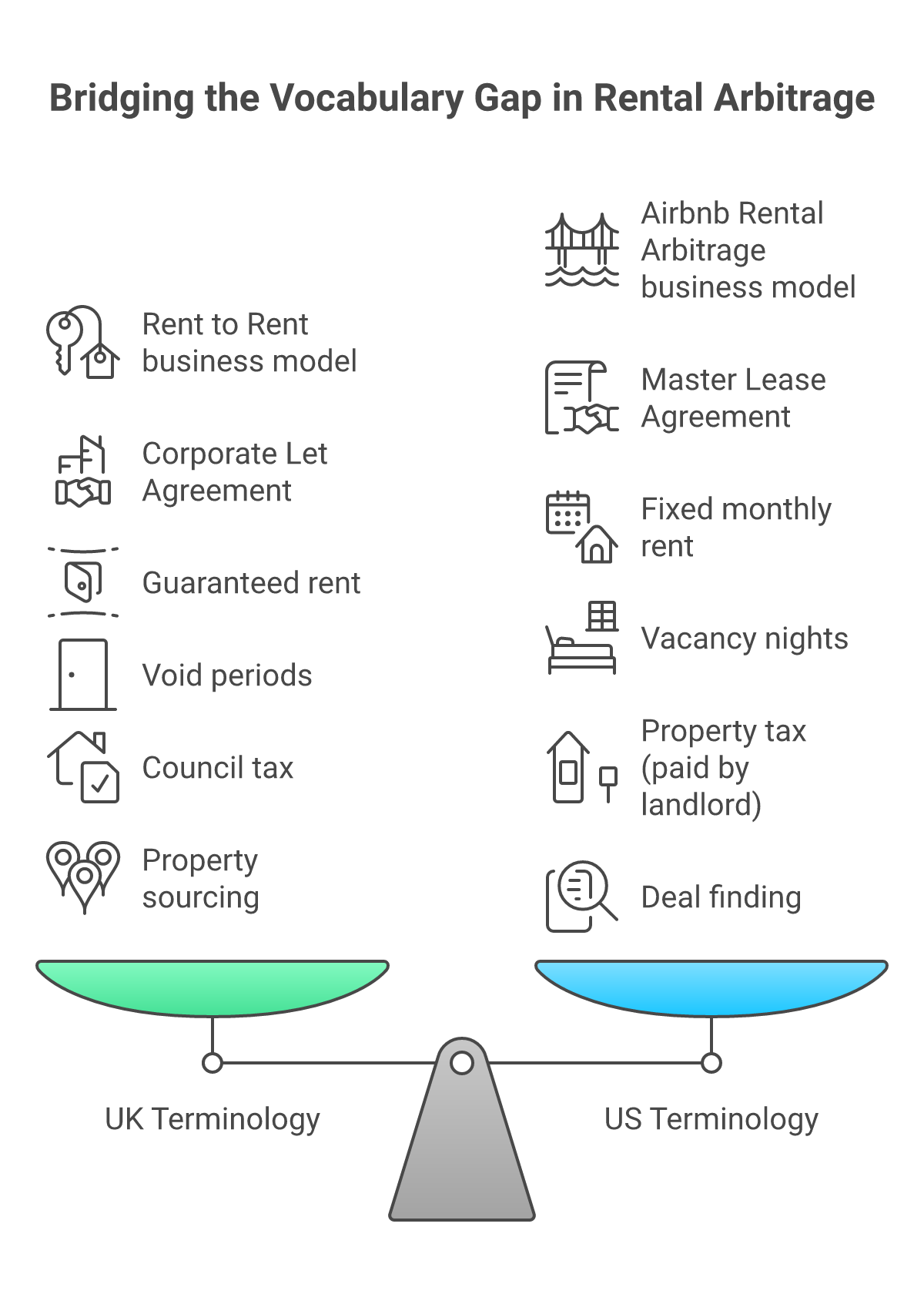
Rent to Rent Airbnb vs Airbnb Rental Arbitrage: Same Model, Different Vocabulary
Most of the language differences between the UK rent to rent model and US airbnb rental arbitrage come down to vocabulary, not strategy.
| Concept | UK term | US term |
|---|---|---|
| The business model | Rent to rent | Rental arbitrage |
| The master lease | Corporate let agreement | Master lease / long term lease |
| Fixed rent to landlord | Guaranteed rent | Fixed monthly rent |
| Empty nights | Void periods | Vacancy nights |
| Local property tax | Council tax | Property tax |
| Finding properties | Property sourcing | Deal finding |
For the rest of this guide, we use “rent to rent Airbnb” to align with UK readers and add the US airbnb rental arbitrage equivalent where the terminology diverges. The actual numbers shift slightly based on currency and market, but the framework is the same.
Is Rent to Rent Airbnb Legal? The Three-Layer Check
Rent to rent Airbnb is legal only when three layers line up: the tenancy agreement permits subletting, local laws allow short term rentals at the property, and the landlord gives explicit written approval. Skip any layer and the deal becomes a liability for both sides.
Layer 1: The Lease Agreement and Subletting Clause
Most standard tenancy agreements in the UK and standard residential leases in the US prohibit subletting by default. To run rent to rent Airbnb legally, you need either a tenancy agreement that explicitly permits short term subletting OR a corporate let agreement structured for commercial use. The corporate let agreement is the cleanest UK option and is the one experienced rent to rent Airbnb operators ask for by name.
If the property owner has a buy to let mortgage, the mortgage terms usually prohibit short term rental subletting unless the lender approves. This is the most common deal-killer in the UK. In the US, the equivalent issue is the lender’s owner-occupancy clause on conventional mortgages. Always confirm the property owner’s mortgage terms before signing.
Layer 2: Local Laws and Short Term Rental Regulations
Local laws vary wildly by city. London restricts short term rental of an entire property to 90 nights per calendar year (the 90-day rule). Edinburgh requires a short term let licence as of October 2023. New York City requires hosts to be present during the booking for stays under 30 days. Per the U.S. Small Business Administration’s state-by-state business registration guide, US operators also need to layer LLC registration on top of city short term rental ordinance compliance.
Check local laws before you sign a lease. Some buildings and HOAs (in the US) or freeholders and management companies (in the UK) prohibit short term rental property use entirely. The lease can permit subletting on paper while the building bans Airbnb in practice.
Layer 3: Landlord Approval
The third layer is the landlord pitch. Even when the lease and the local regulations both permit short term rental arbitrage, you need explicit written approval from the property owner. Verbal approval is not enough. The standard rent to rent Airbnb landlord pitch covers four points: guaranteed rent (whether the property is booked or not), zero void periods for the property owner, full property care including weekly cleans, and a 24-month minimum lease term.
Rent to Rent Airbnb Pros and Cons
The honest pros and cons of rent to rent Airbnb. No hype, no fantasy.
Pros
- Low startup cost compared to buy property. Rent to rent Airbnb launches at £5,000 to £12,000 in the UK or $7,000 to $15,000 in the US. Buying a similar unit requires £30,000 to £80,000 (or $40,000+) in deposit and closing costs.
- Cash flow at scale. A profitable rent to rent Airbnb unit generates £800 to £2,500 monthly net profit, or $1,000 to $3,000 in the US.
- Scalability. Each unit operates independently. The right rental arbitrage host can run 3 to 6 units within 12 to 18 months of the first launch.
- No mortgage debt. You carry a lease obligation, not a 25-year mortgage on the property.
- Skill transfer. Every rent to rent Airbnb unit teaches you market analysis, guest experience, and property management. These skills compound into a buy property career later if you choose.
Cons
- Landlord dependency. If the property owner sells or doesn’t renew the lease, you lose the unit (and your furniture investment unless the new owner buys it).
- Void periods eat into profit. Empty nights are pure cost. Most rent to rent Airbnb units need 60% to 70% occupancy to break even.
- Property damage risk. Guest behaviour varies. AirCover covers some damage but is not a substitute for a proper short term rental insurance policy.
- Local regulation risk. Cities change short term rental rules. London’s 90-day rule, Edinburgh’s licence, NYC’s hosting requirement. Any of these can drop overnight and eliminate your market.
- No long term equity. You build a business asset (the operation, the systems, the brand) but not a property ownership asset.
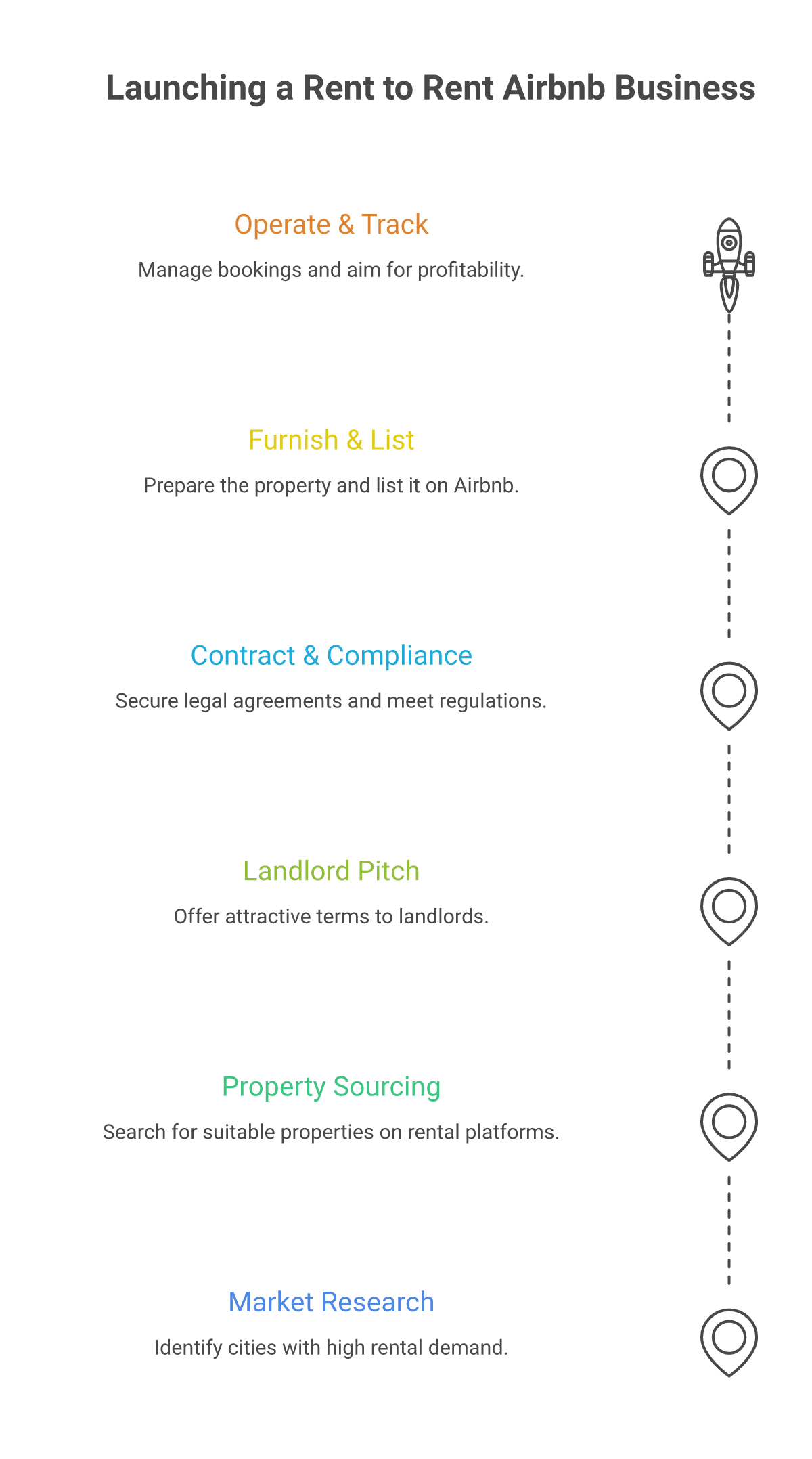
Your 6-Step Plan to Launch a Rent to Rent Airbnb Business
The exact playbook 10XBNB students use to go from zero to a first rent to rent Airbnb unit live within 90 days. Same playbook, two currencies.
Step 1: Market Research and Area Selection
Pick a city or neighbourhood with strong short term rental demand. In the UK, use AirDNA UK, Mashvisor, or Inside Airbnb to check average nightly rate, occupancy, and seasonality. In the US, use AirDNA Rentalizer or Rabbu. The math: a profitable rent to rent Airbnb unit should produce nightly rate times occupancy that equals 2.5x to 3.5x your monthly rent.
Examples of strong UK markets: Manchester city centre, Edinburgh Old Town, Liverpool Albert Dock, Birmingham city centre. Strong US markets per AirDNA 2026: Nashville, Phoenix, Charlotte, Pigeon Forge, Gulf Shores. Avoid markets that just passed restrictive short term rental regulations.
Step 2: Property Sourcing
Search Rightmove, Zoopla, OpenRent (UK) or Zillow, Realtor.com, Apartments.com (US) for long term lease listings. Filter for properties owned by landlords who have held the unit for less than 5 years (more open to new income strategies), or properties listed for over 30 days (motivated landlords). Look for 1 to 2 bedroom flats or apartments near tourist attractions, business districts, or hospitals (mid term rental demand from medical professionals).
Step 3: The Landlord Pitch
The landlord pitch is where rent to rent Airbnb deals get won or lost. Lead with guaranteed rent and zero void periods. Frame the deal as a corporate let agreement, not a short term rental sub-arrangement. Show the property owner a one-page summary: 24-month lease, monthly rent paid on time, professional cleaning weekly, no party policy, and full insurance coverage.
Bring two reference letters from previous landlords (if you have prior rent to rent Airbnb units) or a deposit equal to two months’ rent for your first unit. Most landlord approval cycles take 2 to 4 weeks. Expect to pitch 10 to 20 landlords before getting your first yes.
Step 4: Contract and Compliance
Get the lease agreement in writing. In the UK, use a corporate let agreement reviewed by a property solicitor (£250 to £500). In the US, use a master lease agreement with an explicit short term rental subletting clause reviewed by a real estate attorney ($250 to $600). Both agreements should specifically address: subletting permission, maintenance responsibilities, insurance requirements, and exit terms.
Register your business properly. In the UK, set up a limited company (£50 via Companies House) and register for VAT if you cross £85,000 annual turnover. In the US, form an LLC ($50 to $500 depending on state) and get an EIN from the IRS.
Step 5: Furnish and List
Plan £3,000 to £6,000 (UK) or $3,500 to $7,000 (US) for furniture and supplies on a 1 to 2 bedroom unit. The rooms guests notice: bedroom (bed quality, mattress, blackout curtains), living room (sofa, coffee table, lighting), and kitchen (full cookware stack). Bath and dining cost less but cannot be skipped.
Hire a professional photographer (£150 to £500 / $150 to $500). The photos drive bookings more than any other listing element. List on Airbnb and Vrbo simultaneously to maximise channel coverage. Use dynamic pricing software like PriceLabs ($19.99 per listing per month) from day one.
Step 6: Operate and Track
Daily operations: guest communication, cleaning schedule, supply restocking, maintenance handling, review management. Use Airbnb’s built-in messaging templates for the first 90 days, then move to automation tools like Hospitable or Guesty once you have 2+ units.
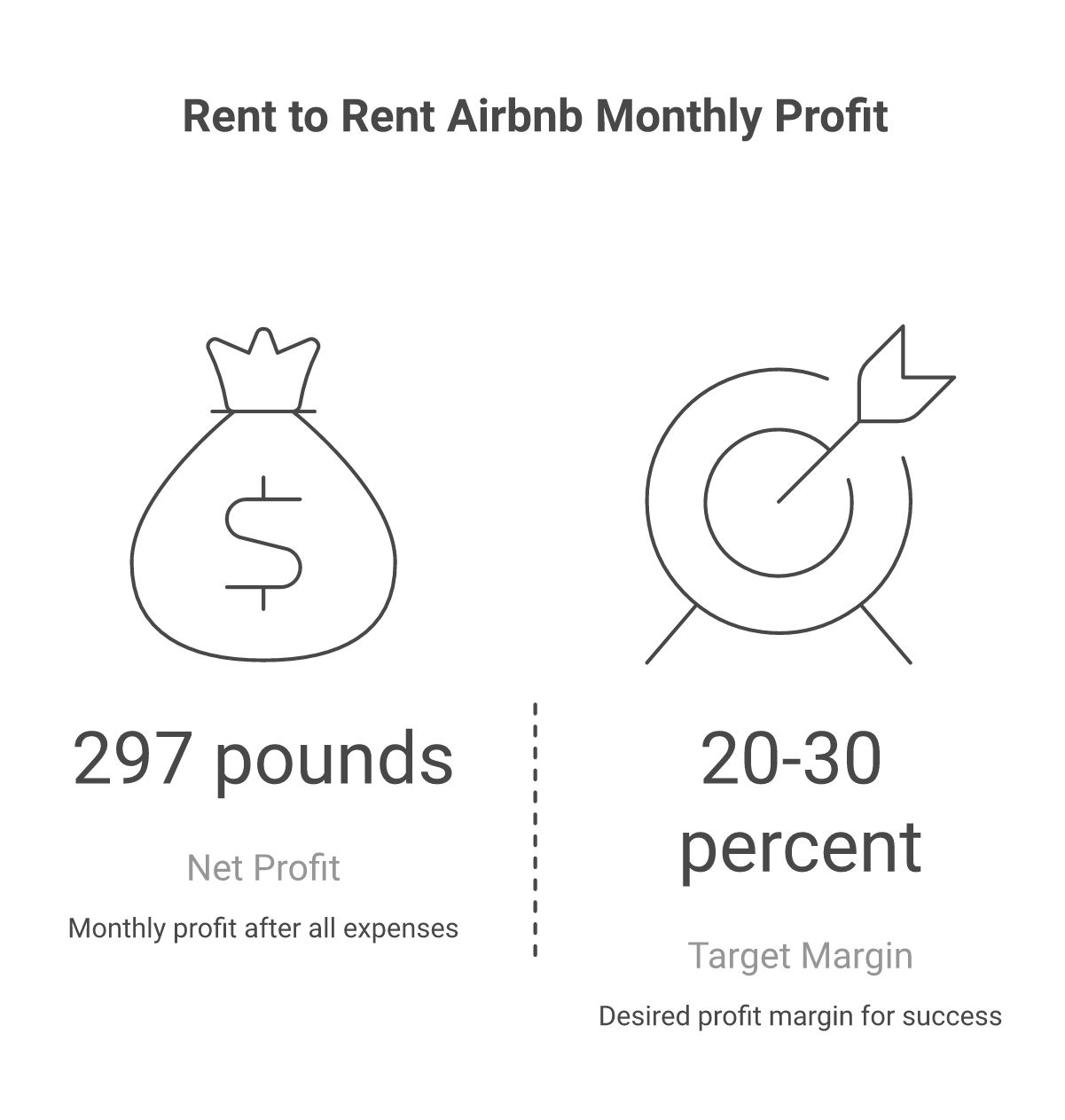
Track monthly: gross revenue, occupancy, ADR, total expenses, net profit margin. The benchmark for a healthy rent to rent Airbnb: 20% to 30% net profit margin. Below 15% and the deal is at risk. Above 35% and you have pricing power to raise rates further.
How to Calculate Rent to Rent Airbnb Profitability
The math is simple. Monthly gross revenue equals average nightly rate times occupancy rate times average nights per month (use 30). Monthly profit equals gross revenue minus the monthly rent plus utilities plus cleaning plus the Airbnb host fee plus insurance plus supplies plus maintenance reserve.
Worked example: 2-bed flat in Manchester, UK
| Line item | Monthly |
|---|---|
| Gross revenue (£140 ADR × 65% occupancy × 30 nights) | £2,730 |
| Monthly rent to property owner | -£1,100 |
| Council tax + utilities + Wi-Fi | -£280 |
| Cleaning (10 turns × £45) | -£450 |
| Airbnb host service fee (15.5%) | -£423 |
| Insurance + supplies + maintenance reserve | -£180 |
| Monthly net profit | £297 |
That example produces a 10.9% net margin. To hit the 20% to 30% target, the unit needs either higher ADR (£170+), higher occupancy (75%+), or lower monthly rent (£900 or below). Most profitable rent to rent Airbnb deals require a combination of all three.
For US numbers, swap pounds for dollars at roughly 1.25 exchange rate and use the same percentage benchmarks. Our free Airbnb arbitrage calculator runs both UK and US deals through the same math and outputs a deal score in under 60 seconds.
Common Rent to Rent Airbnb Pitfalls
The five most common ways new rent to rent Airbnb operators lose money.
1. Verbal landlord approval instead of written. A handshake deal evaporates the moment the landlord wants to sell or the building manager complains. Get every approval in writing, on the lease itself, signed and dated.
2. Underestimating void periods. First-month occupancy is typically 30% to 40%, not the 65% you projected. Build a 60-day operating reserve into your initial investment so you can survive the slow ramp.
3. Ignoring local laws. A £2,500 fine for an unlicensed short term rental in Edinburgh or a NYC violation notice can wipe out a year of profit. Check local regulations before you sign the lease, not after.
4. Mixing personal and business finances. A separate business bank account and accounting from day one. UK operators benefit from limited company structure for tax efficiency. US operators benefit from LLC structure for liability protection and the rules in the IRS Tax Topic 415 on rental real estate.
5. Skipping insurance. AirCover protects against some property damage but excludes loss of rental income, ordinance and law coverage, and many liability scenarios. A standalone short term rental insurance policy runs £40 to £150 per month per unit. Worth every pound.
Frequently Asked Questions
Is rent to rent on Airbnb profitable in 2026?
Yes, when the deal is structured correctly. A well-selected rent to rent Airbnb unit generates 20% to 30% net profit margin (£800 to £2,500 monthly in the UK, $1,000 to $3,000 in the US). The variables that drive profitability: monthly rent below 35% of projected gross revenue, occupancy 60%+, and operating expenses below 30% of revenue. Below 15% margin the deal is at risk.
Is rent to rent legal in the UK and US?
Yes in both countries when three layers align: the lease permits subletting (or you have a corporate let agreement), local laws allow short term rentals at the property, and the property owner gives explicit written approval. Many UK cities and US states allow rent to rent Airbnb with proper permits. London restricts short term rental to 90 nights per year for entire-property listings. NYC requires host presence for stays under 30 days.
How do I convince a landlord to do rent to rent?
Lead with guaranteed rent and zero void periods. Frame the deal as a corporate let agreement, not a sub-Airbnb arrangement. Offer a 24-month minimum lease, professional weekly cleaning, no-party policy, and full insurance. Bring references or a deposit equal to two months’ rent for your first unit. Expect to pitch 10 to 20 landlords before getting your first yes.
What is the difference between rent to rent and rental arbitrage?
None in business model. Rent to rent is the UK terminology for what US operators call airbnb rental arbitrage. Both mean leasing a property long term and re-listing it as a short term rental on Airbnb or Vrbo for the spread. The UK uses different legal documents (corporate let agreement vs master lease), different regulations (90-day rule, licence schemes), and different terminology (guaranteed rent, void periods, council tax). The underlying business model is identical.
How much does it cost to start a rent to rent Airbnb business?
Startup costs range from £5,000 to £12,000 per unit in the UK or $7,000 to $15,000 in the US. The breakdown: first and last month’s rent plus security deposit (£3,300 in the UK example, $5,400 in the US), furniture and decor (£3,000 to £6,000 or $3,500 to $7,000), kitchen and linens (£600 to £1,200 or $800 to $1,500), safety equipment (£200), professional photography (£200 to £400 or $200 to $400), business registration (£50 to £200 or $300 to $800), and a 30 to 60 day operating reserve.
What kind of contract do I need for rent to rent?
In the UK, use a corporate let agreement reviewed by a property solicitor. The corporate let agreement structures the deal as a commercial tenancy rather than a residential assured shorthold tenancy (AST), which gives you the legal right to operate short term rentals. In the US, use a master lease agreement with an explicit short term rental subletting clause, reviewed by a real estate attorney. Both should cover subletting permission, maintenance responsibilities, insurance requirements, and exit terms.
What are the biggest risks of rent to rent Airbnb?
Five risks dominate. Landlord dependency (if the property owner sells, you lose the unit), void periods (empty nights eat into profit), property damage (guest behaviour varies, AirCover is partial coverage), local regulation changes (cities can tighten short term rental rules overnight), and platform dependency (Airbnb and Vrbo can deactivate listings without notice). Mitigate by signing 24-month leases, building a 60-day operating reserve, carrying proper short term rental insurance, monitoring local regulations monthly, and cross-listing on multiple platforms.
Scaling From One Unit to a Rental Arbitrage Business
The first rent to rent Airbnb unit teaches you the operation. Units 2 through 6 build the rental arbitrage business. Most successful rental arbitrage hosts hit the 3-unit mark within 12 months of launching their first short term rental, and the 6-unit mark within 24 months. The short term rental industry rewards systems over hustle once you cross unit 3.
The path from one rental arbitrage unit to a multi-unit short term rental business follows a predictable sequence. Unit 1 is the proof of concept (validate the market, the lease structure, the listing approach). Unit 2 forces you to build operating systems (cleaning rotation, supply restocking, message templates, dynamic pricing). Unit 3 is the inflection point where you decide whether rental arbitrage becomes your full-time business or stays a side income stream.
The rental arbitrage business at 3+ units requires a different operating model. Solo rental arbitrage works for 1 to 2 units. Beyond that, you need either a virtual assistant for guest communication ($5 to $15 per hour) or a full property management platform like Hospitable or Guesty ($30 to $80 per unit per month). 10XBNB students typically transition to a hybrid model around unit 3: VA for messaging, property management software for pricing and channel sync.
Cash Flow Math at 3 Units
A profitable 3-unit short term rental arbitrage business typically produces £2,400 to £7,500 monthly net profit in the UK or $3,000 to $9,000 in the US. The cash flow profile compounds because operating costs scale slower than gross revenue. Cleaning costs scale linearly (more turns = more cleans). Software costs scale per unit but with volume discounts. Insurance scales linearly. Marketing costs barely scale at all once your listings are optimised.
The biggest cash flow risk at 3+ units is correlated void periods. If all three rental arbitrage units sit in the same neighbourhood and the local short term rental industry takes a hit (new regulation, a major event cancelled, an economic downturn), all three units lose revenue simultaneously while monthly rent obligations stay fixed. Diversify across neighbourhoods or markets to mitigate. Most experienced rental arbitrage hosts spread units across 2 to 3 markets by unit 4.
When to Stop Renting and Start to Buy Property
Rental arbitrage and buying property are not mutually exclusive. Most veteran short term rental business operators run both. Rental arbitrage generates cash flow today with low capital. Property ownership builds long term equity and qualifies for depreciation under tax law.
The common transition point: once your rental arbitrage business generates £30,000+ annual net profit in the UK or $40,000+ in the US, you have the capital and the operating track record to buy property using a DSCR loan (investment property loan qualified by rental income, not personal income). At that point your rental arbitrage units become the cash flow engine that funds the down payment on your first owned property. The owned property compounds long term equity while the rental arbitrage business compounds short term rental income.
UK vs US Rent to Rent Airbnb: Key Differences That Affect Profit
The rent to rent Airbnb model is identical on both sides of the Atlantic, but five operational differences affect rental arbitrage profit math.
1. Contract type. UK rent to rent Airbnb operators use a corporate let agreement structured as a commercial tenancy, which legally permits short term rental subletting. US airbnb rental arbitrage operators use a master lease agreement with an explicit subletting clause. Both serve the same purpose. The corporate let agreement requires a property solicitor (£250 to £500). The master lease agreement requires a real estate attorney ($250 to $600). Both are non-negotiable for a legitimate rental arbitrage business.
2. Council tax vs property tax. UK rental arbitrage units pay council tax (£800 to £2,500 annually depending on band). US short term rental property pays property tax (typically 0.5% to 2.5% of property value annually, paid by the landlord). UK rental arbitrage operators absorb council tax as an operating expense. US rental arbitrage operators do not pay property tax directly.
3. Local regulations. The UK has the London 90-day rule (entire-home short term rental capped at 90 nights per calendar year), the Scottish short term let licensing scheme (mandatory since October 2023), and similar emerging rules in Manchester, Birmingham, and Edinburgh. US local laws vary city by city, with stricter regimes in NYC, San Francisco, New Orleans, and Honolulu. Both markets reward rental arbitrage operators who research local laws before signing the lease.
4. Insurance. UK rental arbitrage typically uses GuardHog, Pikl, or Schofield short term let insurance (£40 to £120 monthly per unit). US airbnb rental arbitrage uses Proper Insurance, Slice, or similar STR-specific carriers ($80 to $250 monthly per unit). Both markets penalize operators who rely on landlord-side residential insurance instead of carrying their own short term rental policy.
5. Currency and average daily rate. UK ADR for a 1 to 2 bedroom rent to rent Airbnb unit ranges £80 to £180. US ADR for a comparable airbnb rental arbitrage unit ranges $120 to $250. Both markets price by quality of listing, location, and seasonality. The conversion is roughly 1.25x but pricing power is market-specific.
For a deeper rental arbitrage business plan, see our rental arbitrage business plan template which works for both UK rent to rent Airbnb operators and US airbnb rental arbitrage hosts.
The Bottom Line on Rent to Rent Airbnb
Rent to rent Airbnb is a legitimate short term rental business model. It is the UK terminology for what US operators call airbnb rental arbitrage. The same fundamentals apply in both markets: pick the right area, source the right property, sign the right lease agreement, and run the operation tight.
If you are starting from zero capital, see our guide on how to start an Airbnb with no money for the three near-zero-capital paths. If you want the full operational playbook from market selection to first booking, our rental arbitrage strategy guide covers the US version of the same model in depth. For the broader getting-started picture, our how to start an Airbnb business guide walks through all 14 launch steps.
The 10XBNB system has produced over $5 million in booking fees and 24 properties under management without buying a single one. That track record exists because the rent to rent Airbnb model works when the math is right. Run the numbers, sign the right contracts, and scale unit by unit.
source https://learn.10xbnb.com/rent-to-rent-airbnb/


No comments:
Post a Comment